


Why Is My Boiler Making Noise?
A noisy boiler gives you two useful clues: where the sound starts and when you hear it. A kettle-like rumble from the boiler while it heats water can point to restricted flow or deposits. Gurgling in an upstairs radiator often points to air in the heating loop. A bang inside a gas boiler at ignition needs quicker attention than a few light ticks from a baseboard as it warms up.
If you smell fuel gas, suspect a gas leak, or hear a carbon monoxide alarm, leave immediately. Call 911 from outside and, for a suspected gas leak, contact your gas utility from a safe location. Avoid operating switches or using a phone inside. Wait for responders to say it’s safe to return. U.S. Fire Administration carbon monoxide guidance · Xcel Energy gas-leak guidance
What different boiler noises may mean
Most of the examples below apply to hot-water, or hydronic, heat. A boiler heats water, and a circulator moves it to baseboards, radiators, or radiant-floor tubing. A steam system moves steam to radiators and returns the condensed water. If you’re unsure what you have, check the paperwork or ask when booking service. The same bang can mean something different in each system. Denver heating services
| What you hear | Where and when | What it may point to |
|---|---|---|
| Kettle-like rumbling or whistling | At the boiler after the burner has been running | Localized overheating associated with poor water flow or heat-exchanger deposits |
| A sharp bang or boom | At a gas boiler as the burner lights | A possible ignition or combustion problem |
| A knock or clunk | In a pipe when a zone starts or stops | A moving pipe or an abrupt change in water flow at a valve or check valve |
| Gurgling or trickling | In a radiator, baseboard, or pipe while heat circulates | Air in the loop, sometimes alongside low pressure or poor air removal |
| Light ticking | Along a baseboard as it warms or cools | Metal expanding or contracting at brackets or contact points |
| Buzzing, grinding, or a gravel-like sound | At the circulator when it runs | Air, vibration, pump wear, or a flow or pressure condition affecting the pump |
These patterns help narrow a service call. A technician can verify the source because piping can carry sound well beyond the component that started it. Vaillant’s boiler noise guide · Caleffi’s hydronic troubleshooting guide
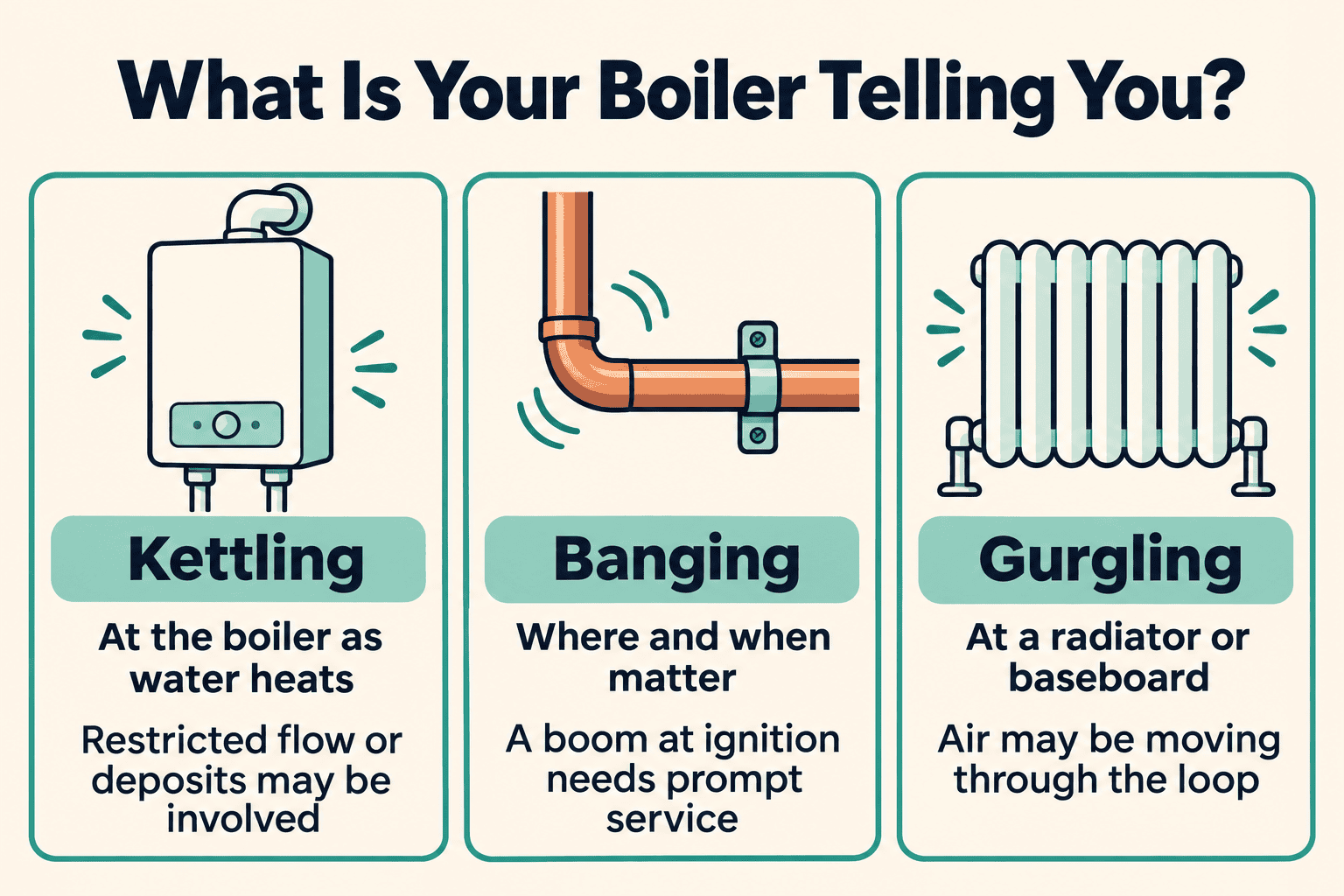
Boiler kettling starts where heat meets water
Kettling is a rumble, pop, or whistle that resembles a kettle heating on the stove. In a hot-water boiler, the burner or heating element adds heat and moving water carries that heat away. Problems at the heat exchanger can create very hot spots where small steam bubbles form and collapse. That makes it possible to hear a kettle-like sound even while the gauge shows a temperature that looks ordinary for that system. Vaillant’s explanation of kettling
Mineral scale can be part of the problem, especially if a closed loop has repeatedly needed fresh makeup water. A restricted strainer, a valve that isn’t opening fully, or a circulator that isn’t moving enough water can also leave the boiler with too little flow. Corrosion debris elsewhere in the system can further restrict circulation. Repeatedly topping up the loop can hide a leak and bring in more oxygen and dissolved minerals. Caleffi’s guide to flow restrictions and corrosion
Notice whether the rumble starts only when one thermostat calls for heat. For example, if it happens when the small upstairs zone runs by itself but the boiler is quiet when several zones are open, that detail can help the technician investigate flow under both conditions. Cleaning decisions depend on what the technician finds and what the boiler manufacturer allows. Teamworks Mechanical’s zoning services
Boiler banging depends on when it happens
A bang as the burner lights
A sharp boom from the boiler cabinet at gas-burner startup can indicate delayed ignition or another combustion fault. Stop using the boiler and arrange prompt service. If the thermostat safely controls that boiler and there is no gas smell or CO alarm, switch the heat call off there. Avoid restarting the boiler to reproduce the sound. A suspected gas leak or CO alarm calls for immediate evacuation. At Denver-area elevations, a technician can check the gas appliance against the manufacturer’s setup and venting requirements for the installation. Laars boiler manual on ignition and noise · Teamworks Mechanical’s guide to Denver altitude and combustion
A clunk in the wall as a zone turns on or off
Water moving through a loop changes speed when a valve opens or closes. A check valve or a quick change in flow can transmit a knock through the pipe. A copper pipe may also bind at a tight framing hole or bracket and release with a pop as it expands. A single clunk at zone shutoff and several ticks during warmup give the technician different starting points. Write down which room or thermostat seems involved. Denver climate control services
A hammering steam radiator or steam main
In steam heat, condensate can collect where a pipe has poor pitch or drainage is restricted. Steam moving through the pipe can pick up that water and drive it into a fitting, causing a hard hammer. The service check may include pipe pitch, condensate return, and radiator or valve configuration. Tell the technician if the hammering is strongest when the system first heats up. Heating Help’s steam water hammer guide
Gurgling can tell you where circulation is breaking down
Picture an upstairs baseboard that gurgles every morning and stays cool while downstairs heats normally. An upper loop can hold an air pocket that interferes with water flow. If the sound returns after a previous purge, the technician can investigate whether the system is losing pressure, whether the air separator is working, and whether the pressure at the upper loop stays adequate as the pump runs. Caleffi’s guide to air and dirt in hydronic systems
If the gurgle comes from a condensing boiler itself, the technician may also check the condensate path where the model calls for it. A gravel-like noise concentrated at the circulator can have several causes, including air or cavitation, which occurs when local pressure drops enough for vapor bubbles to form and collapse. The timing and location help determine what measurements to take. Worcester Bosch’s gurgling guide · Caleffi’s troubleshooting process
What you can safely check before a boiler service call
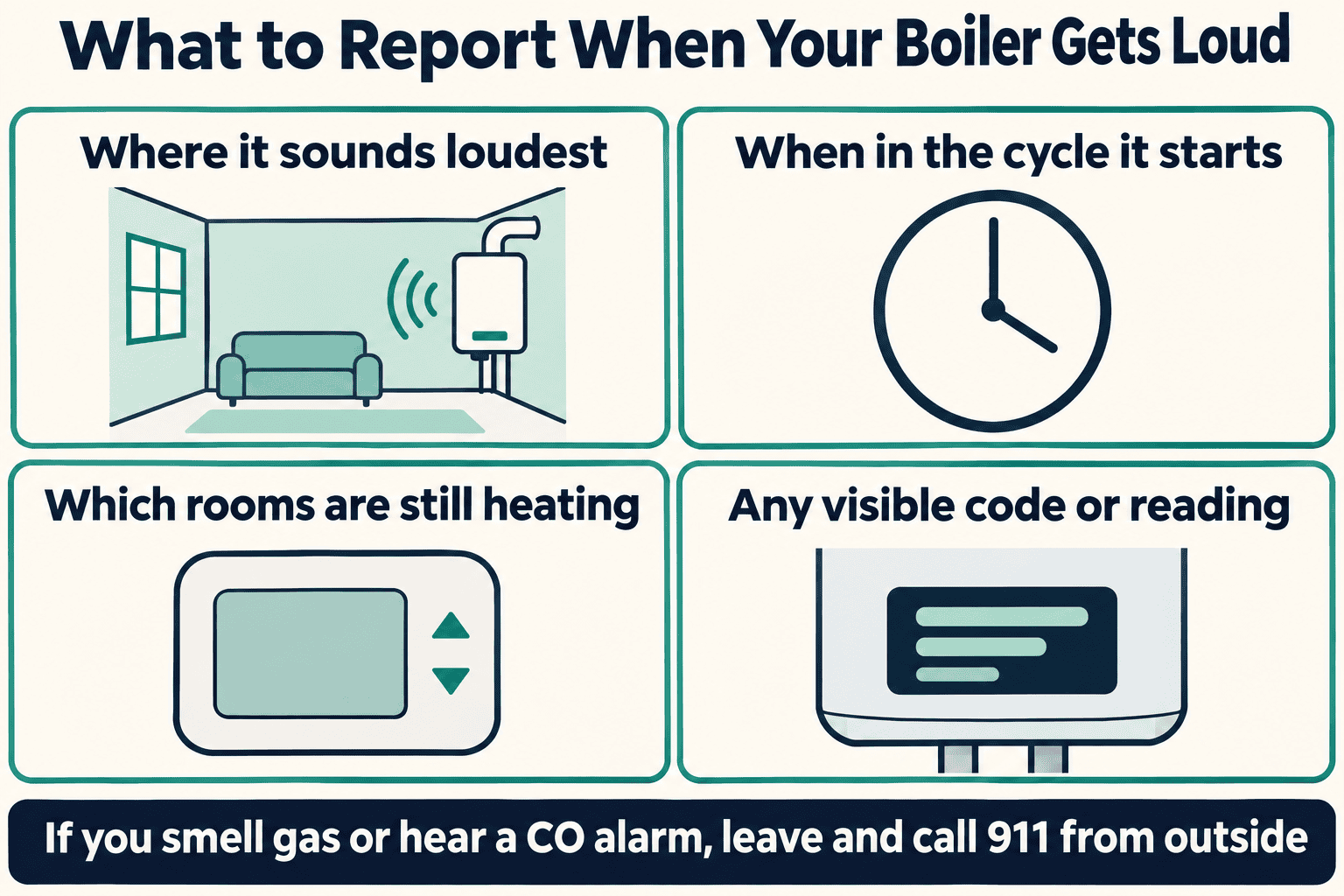
If there’s no gas smell, CO alarm, ignition boom, active discharge, or steam escaping, make a few observations from a dry spot during normal operation.
- Note where it’s loudest. Write down whether the sound seems to come from the boiler cabinet, a visible pump, a pipe, or a radiator or baseboard.
- Note the timing. Record whether you hear it at startup, after several minutes of heating, when a zone shuts off, or while the pipes cool. A short recording from a safe distance can help when the noise is intermittent.
- Track the heat room by room. Identify which thermostat was calling and where heat was weak or absent. If the system has both a boiler and forced air, identify which equipment was running. Why one room can be colder than the rest of the house
- Read what’s visible. Photograph any displayed error code or gauge reading and note when you took it. Check the model manual for its specified operating range. Leave covers, fill valves, bleeders, and relief piping alone while gathering information.
Call promptly for repeated kettling, worsening banging, a new leak, recurring fault codes, or loss of heat during freezing weather. Treat an ignition boom, active discharge from the relief pipe, or escaping steam as urgent. Stay clear of hot water and steam, leave any relief outlet open, and get professional help. Recurring drips at a relief outlet also deserve attention because the expansion tank, fill valve, or relief valve may need evaluation. Caleffi’s guidance on pressure and relief valves
What a technician checks on a noisy boiler
A service visit starts with the boiler type and the event that triggers the sound. For kettling, a technician may compare supply and return temperatures under the conditions that cause the noise, then check pump operation, zone valves, strainers, and the manufacturer’s flow requirements. Temperature readings make more sense alongside information about which zones are open, how hard the boiler is firing, and whether the circulator responds to the call for heat.
For air and pressure complaints, the technician can compare cold and operating pressure, look at expansion-tank behavior and makeup water, and check for leaks and problems with air removal. If an ignition boom is involved, the burner, ignition components, combustion, and venting need their own evaluation. If the appliance actually turns out to be a forced-air furnace that repeatedly starts and stops, the diagnosis follows a different path. Furnace short cycling guide · Denver furnace service
If the visit points to a major repair, ask for the finding behind the estimate and whether other parts of the loop contributed. A new boiler can inherit a restricted zone or a recurring pressure problem if the rest of the system goes unchecked. If replacement is warranted, ask how the proposed equipment will meet the home’s heat load and work with the existing zones. Teamworks Mechanical financing options
Noisy boiler FAQs
Can the expansion tank make my boiler seem noisy?
An expansion tank problem can cause larger-than-expected pressure swings as the water heats and cools. A clue is a relief pipe that drips during heating and stops as the system cools. A technician can compare cold and hot pressure and check the tank, fill valve, and relief valve. Keep the relief outlet open.
Should I bleed a gurgling radiator myself?
First confirm that it’s a hot-water radiator with a manual bleeder and that the manufacturer provides instructions for your system. Steam radiators and many baseboard loops use different hardware. If several rooms are affected, pressure is low, or the gurgling keeps coming back, have the system checked for the source of the air or pressure loss.
Why does my boiler make noise when I run a shower?
A combi boiler can fire to heat tap water even when the room thermostats are satisfied. A boiler connected to an indirect water heater can also fire when that tank calls for heat. Tell the technician if the sound happens only during hot-water use or tank recovery, or if it also happens during space heating.
Is it normal for a boiler pump or fan to run after the heat turns off?
Some models run a circulator or fan briefly after the burner stops as part of a programmed cycle. A short, steady sound that matches the model’s normal sequence can be expected. New grinding, strong vibration, or a sound that lasts much longer than usual is worth reporting.
Does a noisy boiler need to be replaced?
A technician may be able to correct the noise by repairing a valve, circulator, or air-removal problem. Ask about replacement if the diagnosis shows a failed heat exchanger, extensive corrosion, recurring breakdowns, or unavailable parts. Compare the condition of the boiler and the rest of the system before spending money.
Hearing a new noise from your boiler? Call Teamworks Mechanical at 720-447-3157 to request boiler diagnostics in the Denver metro area.

What you should do next
A new sound can be unsettling, especially when the temperature is dropping and you’re counting on the heat. If there are no emergency signs, start with the room, the timing, and whether heat changed. Bring that information and any visible fault code to the service call. If you manage a property, ask tenants to report the affected room and approximate time so the technician can check the right zone.
Teamworks Mechanical can evaluate the boiler and the parts of the heating system that carry water or steam through your property. Explore Denver-area boiler repair and maintenance or request a service visit


