


Why Does My Furnace Keep Turning On and Off? A Guide to Short Cycling
Your furnace starts. Warm air reaches the living room. Then the heat stops—only to start again a little later. By the time you settle back into what you were doing, you hear another startup.
That pattern can leave you wondering whether the furnace needs a new filter, a repair, or replacement. The answer starts with a more useful question: What is ending the heating cycle?
Sometimes the thermostat has received enough warmth and is doing its job. Sometimes the furnace is interrupting its own operation because something is wrong. Those situations can sound similar from upstairs, but they call for different responses.
This guide focuses on residential forced-air gas furnaces, including the high-efficiency equipment common in Denver-area homes. Electric furnaces, oil furnaces, boilers, and heat pumps have different operating sequences and need equipment-specific diagnosis.
Also Read: How Denver’s High Altitude Affects HVAC Performance
The Short Answer: Why Does a Furnace Keep Turning On and Off?
A furnace may keep turning on and off because of restricted airflow, overheating, a flame-sensing or ignition problem, thermostat issues, venting or condensate trouble, or equipment that is too large for the heating load. Repeatedly stopping before the home reaches the set temperature deserves professional diagnosis. Check accessible filters, grilles, and thermostat settings first; leave internal repairs and safety controls to a qualified HVAC technician.
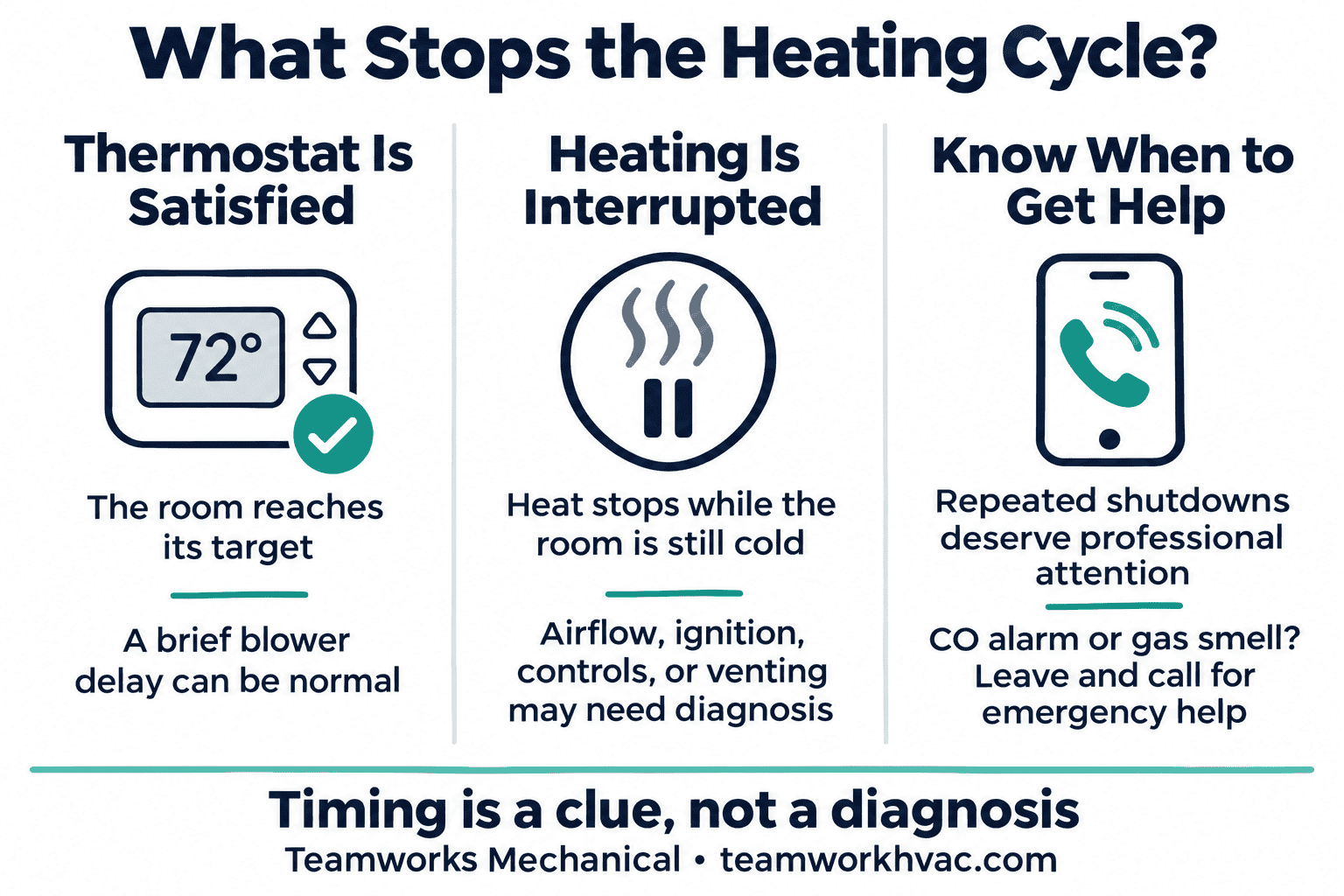
Trane’s short-cycling guidance describes interrupted heating before the thermostat’s target is reached. Timing is a clue, but it cannot identify the failed part by itself.
- Watch the heating pattern and the room temperature together.
- Keep the filter and accessible air paths in proper condition.
- Record recent changes, unusual sounds, and visible error messages.
- Arrange service if repeated interruptions continue.
- Leave immediately for a suspected gas leak, CO alarm, smoke, or symptoms suggesting a combustion emergency.
What Is Furnace Short Cycling?
Short cycling describes repeated heating operation that ends too soon or occurs too frequently for the conditions. Homeowners often use the phrase for several different problems: burners that briefly ignite and quit, heat that repeatedly stops while the fan keeps running, or complete heating cycles that seem unusually frequent.
A furnace does not run continuously whenever it is cold outside. It normally starts and stops as the home needs heat. A shorter cycle on a mild afternoon can be reasonable. A sudden change from the furnace’s usual behavior, especially with poor comfort or repeated retries, carries more diagnostic value than a single short run.
Also Read: Why Does My Furnace Smell When I Turn It On for the First Time?
Why There Is No Universal Normal Cycle Length
Outdoor temperature, insulation, thermostat settings, heating capacity, staging, and indoor heat gains all influence runtime. A single-stage furnace delivers its available heating output whenever the burners operate. A two-stage or modulating furnace can operate at a lower output, often allowing longer heating periods under lighter loads.
A blanket rule such as “anything under ten minutes means a broken furnace” can mislead homeowners. Likewise, a furnace that runs longer than ten minutes can still have an overheating or control problem. Equipment behavior needs context.
Resideo’s VisionPRO installer documentation includes different cycle-rate recommendations for different heating equipment. Those settings belong to that control and application; they are not universal targets for every home. A professional should verify the thermostat’s setup against the installed equipment.
Also Read: Furnace Tune-Up vs. Furnace Inspection
Understand What Is Actually Turning Off
A gas furnace contains several moving parts and controls. Hearing a fan does not establish that the burners are operating. Feeling cooler air after a heating period does not establish a malfunction either: the blower may be completing its normal shutdown delay.
In a typical modern gas furnace, a heat call starts a sequence involving draft verification, ignition, flame confirmation, and then indoor-air circulation. When the thermostat is satisfied, the burners shut off, and the blower usually runs for a programmed period afterward. Exact sequences and delays vary by model.
During a fault, the sequence may stop before ignition or interrupt established heating. Carrier explains that an overheating shutdown can stop the burners while the blower continues cooling the furnace. That distinction helps explain why the house can feel chilly even though the furnace sounds busy.
| What You Notice | What It May Suggest | Useful Next Step |
|---|---|---|
| Heat stops near the set temperature; the blower runs briefly afterward | A normal satisfied heat call and blower delay | Watch comfort and the overall pattern |
| Burners start, then stop almost immediately | Flame confirmation, ignition, gas, or another control problem | Arrange professional diagnosis |
| Warm air becomes cooler while the room remains below setpoint | A safety interruption, airflow problem, or another fault | Check accessible air paths; request service if repeated |
| Frequent complete cycles quickly warm the thermostat area but leave bedrooms cold | Distribution, thermostat location, sizing, or control issues | Request a system-level evaluation |
| The thermostat display also restarts or goes blank | A control-power interruption, wiring issue, or protective device | Record the display behavior for the technician |
These are diagnostic clues, not a parts-shopping chart. Observe from normal living areas or an existing viewing window. Keep furnace panels fitted during operation.
Common Reasons a Furnace Keeps Turning On and Off
1. A Dirty or Unsuitable Air Filter Restricts Airflow
The furnace has to transfer heat into moving household air. If a filter becomes heavily loaded, less air may move through the equipment. Heat can build up faster than the air carries it away.
A filter can also create trouble when it is the wrong size, poorly fitted, or unsuitable for the system’s available airflow capacity. A newly installed filter is not automatically an appropriate filter.
MERV describes particle-removal performance. It does not, by itself, tell you the installed filter’s resistance at your system’s airflow. Filter depth, surface area, construction, and loading matter too. Tell the technician if the shutdowns began after changing filter type.
Use the size and type approved for your system, follow the airflow arrow, and follow the owner’s manual when replacing an accessible filter. Do not stack filters or operate without a required filter to see whether the furnace runs longer. Carrier’s troubleshooting checklist identifies the filter and unobstructed supply and return vents as basic checks before service.
2. Blocked Grilles or Restrictive Ductwork Reduce Heat Removal
A couch over a return grille, curtains covering a register, or numerous closed supply vents can change airflow. Problems can also be hidden: undersized returns, a restrictive fitting, damaged ductwork, or a dirty internal coil.
The evaporator coil used for air conditioning often sits in the furnace’s air path. Its condition can therefore matter during heating season, even though the air conditioner is off. A clean filter cannot correct an obstruction elsewhere.
Our guide to static pressure in HVAC systems explains how measurements help evaluate resistance. For a cycling complaint, pressure readings should be interpreted with the actual blower data and heating mode. A generic pressure number cannot explain the whole system.
Keep ordinary supply registers open and grilles clear unless a qualified technician has established a specific balancing arrangement. Do not adjust internal dampers or zoning equipment by trial and error.
3. The Furnace Is Overheating and Opening a High-Limit Control
A high-limit control is part of the furnace’s protection against excessive temperature. Repeated limit operation can produce a frustrating pattern: heating begins, burners stop, the blower continues, and heating later attempts to resume.
The control may be reacting correctly to an underlying problem. Replacing it without determining why temperatures are excessive can leave that problem unresolved. Restricted airflow, blower trouble, an incorrect setup, and excessive heat input are possible avenues for professional investigation.
Trane’s limit-switch guidance warns against bypassing or resetting this safety control yourself. A safety device that interrupts operation is a reason to investigate conditions, not an obstacle to work around.
4. The Flame-Sensing Circuit Does Not Confirm Combustion
When a modern gas furnace establishes flame, the control must confirm it. If the expected signal is missing or inadequate, the control can close the gas valve. Homeowners may hear repeated startup attempts with little useful heat.
A dirty or damaged flame sensor is one possible cause, but wiring, grounding, flame characteristics, gas supply, and controls can produce similar symptoms. Carrier’s flame-sensor guidance describes this distinction and recommends qualified service for internal components.
“It shuts off after a few seconds” is useful information for the service call. It is not enough evidence to authorize a particular replacement part. Leave sensor cleaning, ignition repairs, and burner work to a trained technician.
5. The Thermostat Ends Heat Calls Too Quickly
A thermostat responds to the temperature at its sensor, which may not represent the rest of the home. Direct sunlight, nearby heat-producing devices, a supply-air stream, or an unsuitable location can affect the reading.
Smart controls add other possibilities. Schedules, remote sensors, occupancy features, and equipment configuration can affect when the system runs. A recent thermostat installation is especially useful history.
Check ordinary user settings: Heat mode, a reasonable stable setpoint, the active schedule, and batteries if applicable. Avoid changing installer settings or moving wires. Lowering the cycle rate without a diagnosis may simply change the appearance of an unresolved problem.
If the fan is set to On, it may circulate air between heating calls. That can explain fan noise or cooler air without explaining repeated burner shutdowns. Treat fan behavior and burner behavior as separate observations.
6. The Furnace Produces More Heat Than the Home Currently Needs
An oversized furnace can warm the thermostat area quickly and end a heat call before warmth spreads evenly. This is different from an overheated furnace stopping on a safety control, although sizing and airflow problems can exist together.
Capacity should be evaluated against the home’s heating load and the equipment’s available output at the installation conditions. ACCA Manual J addresses residential load calculations, while Manual S addresses equipment selection using loads and manufacturer performance data.
Floor area alone does not settle sizing. Windows, insulation, infiltration, layout, design conditions, and improvements to the building all matter. A furnace that once served a drafty house may behave differently after substantial air sealing and insulation improvements.
7. Venting, Combustion Air, or Condensate Problems Interrupt Operation
Gas furnaces need suitable combustion air and an approved way to discharge combustion products. Condensing furnaces also need a properly configured condensate system. Problems in those systems can prevent a heating sequence from completing.
Pressure-switch faults, for example, require investigation of the conditions the switch monitors. A fault does not automatically establish that the switch itself is defective. Relevant checks may involve vent configuration, draft-inducer operation, pressure connections, and drainage, depending on the model.
The Carrier 59SC5B installation and service instructions illustrate why these details are model-specific: venting, condensate arrangements, operating checks, and setup instructions belong to a particular furnace design. A generic internet repair procedure cannot replace the installed model’s documentation.
From a safe ground-level location, note obvious snow, debris, ice, damage, or water near accessible terminations and drains. Do not remove vent fittings, open traps, disconnect pressure tubing, chip ice from piping, or climb to inspect a roof vent.
8. A Blower, Electrical, or Control Problem Disrupts Heating
A blower that fails to move the required air can create a heating interruption even when all visible grilles are clear. Electrical connections, motor controls, relays, control boards, and low-voltage power can also cause intermittent behavior.
A thermostat display that goes blank at the same moment the furnace stops is different evidence from a thermostat that continues to show a heat call. Share that observation without assuming which component caused it.
Do not tighten internal connections, test live circuits, or repeatedly reset a tripped breaker. These conditions need appropriate electrical testing and a diagnosis that follows the equipment’s sequence of operation.
Also Read: What Is Static Pressure in HVAC?
Why Denver Conditions Matter
Altitude Affects Setup and Available Performance
Denver’s elevation makes manufacturer-approved altitude guidance relevant to furnace commissioning and diagnosis. Air density and combustion setup must be considered together with equipment-specific performance information.
The appropriate procedure depends on the model, fuel characteristics, and installation elevation. Avoid a single derating percentage copied from another furnace. Correcting burner input or changing an orifice is professional work.
Our article on Denver’s high altitude and HVAC performance explains the local context. Altitude is a reason to verify setup carefully; it does not make recurring safety shutdowns acceptable.
Mild Afternoons and Cold Nights Create Different Loads
Consider a home that receives strong afternoon sun but needs much more heat after sunset. The same furnace can reasonably run shorter heating periods in daylight and longer periods overnight. Compare behavior at similar outdoor conditions before concluding that every change represents deterioration.
Conversely, repeated interrupted heating on a cold night, with indoor temperature falling, deserves prompt attention. “Colorado weather changes quickly” does not explain away a furnace that repeatedly fails to deliver needed heat.
Older Homes and Renovations Can Change the Air Path
A remodeled basement, newly finished room, relocated grille, or added zoning can change the system the furnace serves. A previous equipment replacement may also have changed the required airflow while leaving older ductwork in place.
Where a restriction is measured, the solution may involve a filter arrangement, return path, or duct transition. Teamworks Mechanical’s custom HVAC duct fabrication services can be relevant when a specific duct modification is needed. Duct replacement should follow an identified need rather than a generic response to cycling.
What You Can Safely Check Before Calling
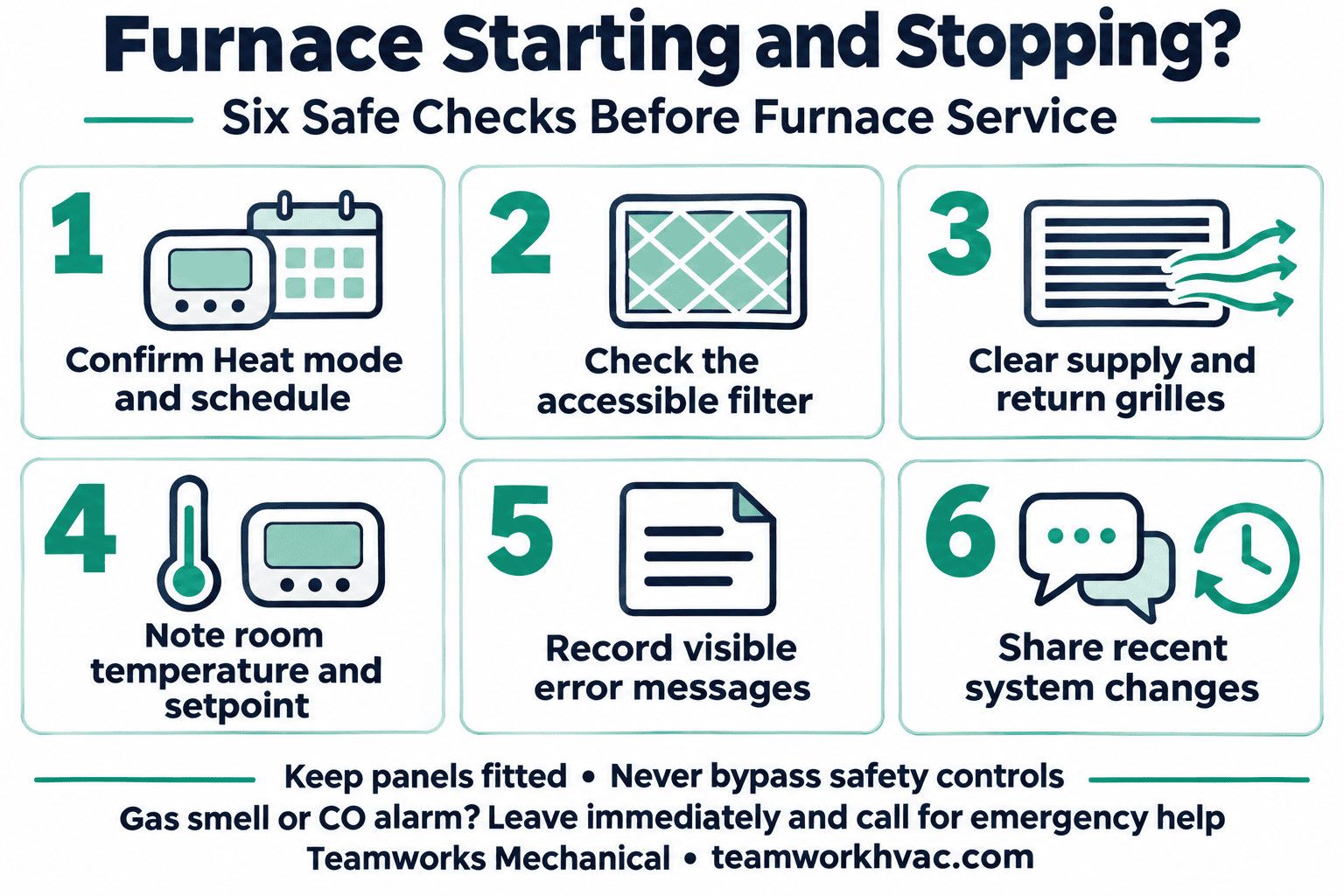
Start with safety. If there is no gas odor, CO alarm, smoke, or other immediate warning, a few accessible checks can provide useful information. If the furnace repeatedly shuts down, stop troubleshooting and arrange service.
- Check the thermostat. Confirm Heat mode, the current room reading, a stable setpoint, and the active schedule. Replace user-serviceable batteries according to the control’s instructions.
- Check the accessible filter. Follow the owner’s manual, including shutting equipment off as directed. Use the correct replacement and refit covers properly. If access is unclear or requires working near internal components, leave it for service.
- Clear ordinary supply and return grilles. Move rugs, curtains, furniture, and stored items away from airflow openings. Avoid changing a professionally established balancing setup.
- Observe the pattern. Record room temperature, setpoint, approximate heating duration, and whether the blower continues after useful heat stops. You do not need to let repeated failures continue to build a log.
- Record visible information. Photograph an externally visible diagnostic display or existing viewing-window code if safely accessible. Keep panels in place and tell the technician about any reset already performed.
- Share recent changes. A new filter, thermostat, renovation, vent adjustment, or previous repair may help focus the evaluation.
Do not remove an operating furnace’s panel, hold down a door switch, bypass a safety device, or keep cycling power to restore heat. If the pattern persists after basic checks, turn heating off at the thermostat if safe and request service. For a suspected gas leak, leave without touching the thermostat or switches.
When to Stop Using the Furnace and Get Help
Short cycling does not prove carbon monoxide exposure or a cracked heat exchanger. It also cannot establish that the furnace is safe. Some accompanying signs require an immediate change in response.
| Situation | What to Do |
|---|---|
| CO alarm or symptoms suggesting possible CO exposure, such as headache, dizziness, nausea, or confusion | Move everyone outside to fresh air immediately and call 911. Do not reenter until responders allow it. |
| Rotten-egg or sulfur-like gas odor | Leave immediately. Do not operate switches, the thermostat, phones, or garage-door openers inside. Call 911 and the gas utility from a safe location. |
| Smoke, visible fire, or an explosive ignition sound | Leave for smoke or fire and call 911. Do not restart equipment after a violent or delayed ignition event; arrange urgent qualified assessment. |
| Harsh electrical burning odor without smoke or fire | Stop operation if safe and arrange prompt professional assessment. |
| Repeated shutdowns, lockouts, or inability to maintain a safe indoor temperature | Request prompt furnace service and use a safe alternative location if the home becomes too cold. |
The CPSC’s carbon monoxide guidance says to move outside and contact emergency services when a CO alarm sounds. Xcel Energy’s gas-safety guidance advises leaving before operating devices when a gas leak is suspected. A silent CO alarm does not replace professional combustion and venting evaluation.
If unusual odors accompany the cycling, see our guide to furnace smells at the first seasonal startup. Do not dismiss a gas or electrical odor as ordinary startup dust.
What a Professional Short-Cycling Diagnosis Should Establish
A useful service visit should connect the observed interruption to evidence. The objective is to explain why the sequence stops and verify that the corrective work restores appropriate operation.
Identify the Event That Ends Heating
The technician can determine whether the thermostat withdrew its heat call, the control lost power, flame confirmation failed, a limit opened, or a pressure-related condition interrupted the sequence. Fault history can help, but a code identifies a condition or circuit; further testing establishes the cause.
Check Heat Input, Airflow, and Temperature Rise Together
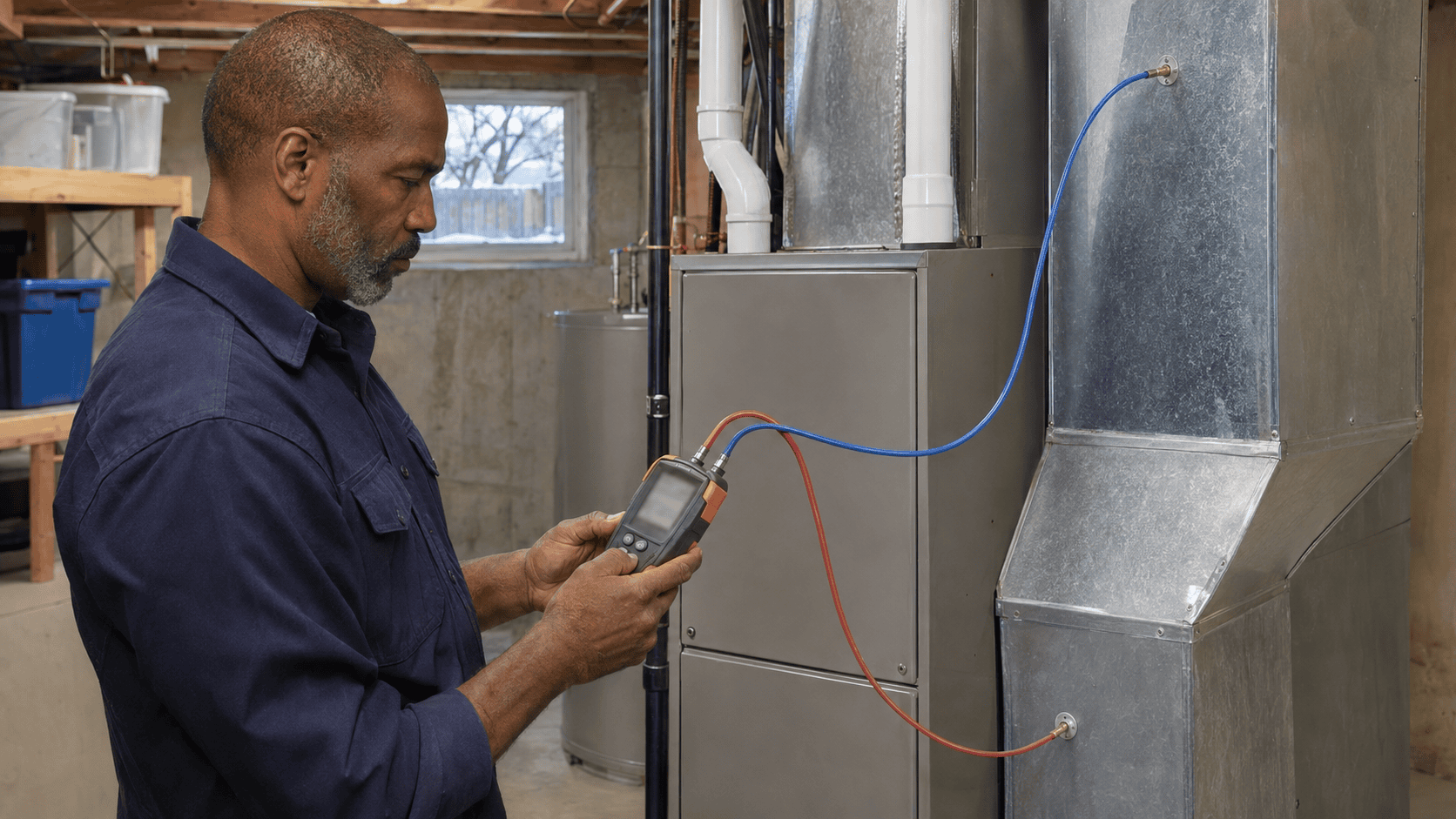
Temperature rise is the difference between appropriately measured return-air and supply-air temperatures during heating. It should be evaluated using the furnace’s stated range and the operating stage. The reading needs suitable test locations and stabilized operation.
A hypothetical illustration: return air at 68°F and supply air at 118°F produce a 50°F rise. That arithmetic does not make 50°F correct for your furnace. The equipment rating, stage, input, and measurement procedure determine whether it is appropriate.
Similarly, static pressure alone is incomplete. A good explanation relates pressure readings to the installed blower’s performance data and locates meaningful restrictions. This helps distinguish an air-delivery problem from a heating-input or control problem.
Also Read: Why Is One Room Colder Than the Rest of My House?
Evaluate Combustion and Venting Where Relevant
A gas-furnace evaluation may include burner operation, gas input, applicable altitude adjustments, venting, combustion air, and instrumented checks appropriate to the equipment. The Department of Energy’s combustion-equipment guidance explains how venting and building pressure can affect susceptible combustion appliances.
Home improvements deserve attention here too. A newly enclosed equipment space or changes to exhaust ventilation may affect a system differently from a sealed-combustion installation. Teamworks’ ventilation and humidity-control services address related whole-home conditions; appropriate testing determines which conditions matter to the cycling complaint.
Verify Performance After the Correction
Ask what changed and how the result was checked. A repair should be followed by appropriate operating verification, including the conditions that originally produced the symptom where practical. If intermittent weather or zone conditions cannot be reproduced, that limitation should be explained.
Useful questions include: Was the thermostat still calling for heat? Which safety or control interrupted operation? What readings supported the diagnosis? What was checked after the work? These questions make a service recommendation easier to understand.
Three Examples That Show Why the Pattern Matters
The following are hypothetical teaching examples, not reports of Teamworks customer visits.
The Filter Change That Preceded New Shutdowns
A homeowner switches to a different filter design. Soon afterward, heating repeatedly stops while the blower continues. The timing makes filter resistance worth investigating, but it does not prove the filter is the only issue. A technician checks the approved filter arrangement, pressure conditions, airflow, and temperature rise before recommending a correction.
The Furnace That Behaves Differently When One Zone Calls
A zoned system heats normally when several zones need warmth but interrupts heating when only a small bedroom zone calls. The important clue is the active air path. A professional evaluates minimum airflow, damper operation, control staging, and equipment compatibility. Teamworks’ HVAC zoning services are relevant to that system-level review.
The Sunny Thermostat and Cold Back Bedroom
The thermostat reaches its target quickly in afternoon sunlight while a shaded bedroom stays cool. The furnace may be completing valid heat calls based on an unrepresentative sensor location. Replacing a flame sensor would not address that relationship. A review of sensing, distribution, and room conditions is more useful.
The shared lesson is practical: ask what changed, what ends the cycle, and where the warmth goes. Those questions help prevent a recognizable symptom from becoming an unsupported diagnosis.
Also Read: What Happens When Heating or A/C Systems Fail in Denver Homes?
Can Short Cycling Damage a Furnace or Raise Heating Costs?
Repeated abnormal starts and interruptions can add wear and prevent comfortable heat delivery. An unresolved airflow or combustion problem matters beyond the inconvenience of hearing the furnace start again.
The energy effect varies. Short cycles do not establish a specific fuel-waste percentage, and a bill cannot be diagnosed without accounting for weather, rates, thermostat settings, and household changes. The Department of Energy’s furnace guidance identifies oversizing and poor distribution as factors that can reduce efficiency and comfort.
Focus first on restoring correct operation. Afterward, compare performance under reasonably similar conditions. A quieter furnace is welcome, but stable comfort and verified operating measurements provide stronger evidence of a successful correction.
Should You Repair or Replace a Short-Cycling Furnace?
Short cycling alone is not a replacement diagnosis. A correct filter, control adjustment, targeted repair, or airflow correction may resolve the cause. Replacement becomes a more substantial consideration when there is a confirmed major failure, repeated expensive breakdowns, unsuitable capacity, or a broader mismatch between equipment and the home.
Ask for an explanation of the confirmed fault, the repair scope, available warranty coverage, and whether the existing duct system can support the proposed solution. If replacement is recommended for sizing reasons, ask how the home’s load and the selected equipment were evaluated.
A new furnace connected to the same unresolved restrictive air path may inherit a performance problem. Teamworks’ furnace repair and replacement services provide a starting point for discussing the options. The recommendation should follow the findings and your goals for the home.
Costs depend on the diagnosed cause, equipment, access, parts, and installation conditions. Request a written scope rather than relying on a national average for a symptom that can represent very different work.
Also Read: Is Your HVAC System Properly Winterized for Colorado’s Climate?
How to Reduce the Chance of Recurring Problems
Check the filter’s condition regularly and follow the equipment and filter manufacturer’s maintenance guidance. Keep grilles clear, preserve service clearance around the furnace, and avoid using the equipment space for storage that interferes with ventilation.
Arrange professional maintenance on the schedule appropriate to the equipment, including an annual assessment for a fuel-burning furnace. Teamworks’ Denver heating services include maintenance and repair. Explain recurring symptoms when booking; a specific intermittent fault may require diagnostic work beyond a routine tune-up.
Maintain CO alarms according to their instructions, including replacement at the end of their rated life. Before changing thermostats, adding zones, upgrading filtration, or remodeling near the equipment, consider the effect on the complete system.
For ongoing comfort problems involving several rooms or controls, a whole-home climate-control evaluation can help connect the furnace complaint with the distribution system. Maintenance can reduce some preventable problems, but it cannot guarantee that a component will never fail.
Frequently Asked Questions About Furnace Short Cycling
Why Does My Furnace Keep Turning On and Off Every Few Minutes?
Restricted airflow, overheating, thermostat issues, venting or drainage problems, and other control faults can cause repeated interruptions. Timing alone cannot identify the cause. Check accessible filters and grilles, and arrange professional service if the pattern continues.
How Long Should a Furnace Run During Each Cycle?
There is no universal cycle length. Outdoor conditions, heating load, furnace capacity, staging, and thermostat configuration affect runtime. A sudden change, poor comfort, or repeated shutdowns before the home warms deserves attention.
Can a Dirty Filter Cause Furnace Short Cycling?
Yes. A loaded or unsuitable filter can restrict airflow and contribute to overheating. Use the specified filter and follow the owner’s manual. If repeated shutdowns continue after an appropriate replacement, request professional diagnosis.
Why Does the Fan Keep Running After the Furnace Stops Heating?
A brief blower delay after a satisfied heat call can be normal. The blower may also continue after an overheating shutdown to cool the furnace. Repeated loss of heat while the room remains below setpoint should be evaluated.
Can a Thermostat Cause a Furnace to Short Cycle?
Yes. Sensor location, configuration, wiring, or control-power problems can affect heat calls. Check ordinary user settings and batteries if applicable. Leave installer settings, wiring, and compatibility checks to a qualified technician.
Why Does My Furnace Ignite and Then Shut Off Almost Immediately?
The control may not be confirming flame, but ignition, gas supply, wiring, grounding, and other faults can produce similar symptoms. A flame sensor is one possible cause. Internal diagnosis and repair should be performed by a qualified professional.
Is Furnace Short Cycling Dangerous?
Short cycling does not prove an immediate hazard, but repeated safety shutdowns require attention. Leave immediately for a CO alarm, suspected gas leak, smoke, or symptoms suggesting CO exposure, and call emergency services from a safe location.
Should I Keep Resetting a Furnace That Short Cycles?
No. Repeated resets do not correct the cause and may clear useful fault information. Do not bypass controls or reset internal safety switches. Stop operation if safe and arrange professional service for recurring shutdowns.
Does Denver’s Altitude Cause Furnace Short Cycling?
Altitude affects equipment setup and performance, so the installed furnace’s altitude instructions matter. It does not make repeated safety shutdowns normal. A professional can verify the applicable setup, heating input, airflow, and operating conditions.
Does a Short-Cycling Furnace Need to Be Replaced?
Not necessarily. Filter, airflow, thermostat, or component problems may be repairable. Replacement should follow diagnosis and consideration of safety, condition, repair history, capacity, warranty, and the home’s heating needs.

What You Should Do Next
You should not have to spend a cold Denver evening listening for the next furnace restart or wondering whether the house will stay warm. Start with the checks you can safely make: confirm the thermostat settings, inspect the accessible filter, clear the grilles, and note what happens when heating stops.
If the furnace continues turning on and off, arrange a professional diagnosis before relying on it through colder weather. Tell the service team whether the home reaches its set temperature, whether the blower keeps running, and whether anything changed shortly before the problem began.
Teamworks Mechanical can evaluate the furnace and related airflow conditions, explain the findings, and discuss the repair or improvement that fits the diagnosis. You can ask what was measured, why the recommended work is needed, and how operation will be checked afterward.
Call 720-447-3157 or request furnace service online. You do not need to identify the faulty part before reaching out. A clear description of the pattern is a useful first step toward dependable heat and a more comfortable home.


