


Your furnace runs, but the bedroom stays cold. The return grille whistles whenever the blower starts. The air conditioner takes longer to cool the house, even after you replace the filter.
These problems can have several causes, but they share an important question: Can your HVAC system move the air your home needs through the ductwork it actually has?
Static pressure testing helps answer that question.
An HVAC system must do more than produce warm or cool air. It must circulate that air through filters, equipment, ducts, and registers—and bring room air back again. When that path becomes too restrictive, comfort and performance can suffer.
For Denver homeowners, understanding static pressure can help turn a vague complaint such as “the heat doesn’t reach this room” into a measurable diagnostic process.
Before buying a bigger HVAC system, find out whether the existing system can move air properly through your home.
The Short Answer: What Is Static Pressure In HVAC?
Static pressure is the pressure air exerts within an HVAC system. Technicians use static pressure measurements to evaluate the resistance the blower must overcome as it circulates air.
Filters, coils, ducts, fittings, and grilles all contribute resistance. Some resistance is expected. Problems arise when the equipment cannot deliver the required airflow within its approved operating limits.
Static pressure and airflow are related, but they are different measurements:
| Measurement | What It Tells You |
|---|---|
| Static pressure | The pressure conditions within the air distribution system |
| Airflow | How much air moves through the system, commonly measured in cubic feet per minute, or CFM |
| Temperature change | How much the equipment warms or cools the air passing through it |
| Room temperature | The comfort result in a particular space |
A system can make noise and move some air while still failing to deliver enough airflow. Carrier’s homeowner guidance identifies weak airflow, uneven temperatures, and whistling ducts as reasons to investigate airflow and static pressure. HVAC Airflow Meaning & Calculation
Why Your HVAC System Needs A Complete Air Path
Your home’s forced-air system operates as a connected loop.
Return ducts carry room air back to the equipment. The blower moves that air through the system, and supply ducts distribute conditioned air into living spaces.
Both sides matter.
A large supply duct cannot compensate for an inadequate return path. A powerful blower cannot guarantee comfort if a bedroom receives too little air or cannot return it when the door closes.
The Department of Energy explains that properly designed return paths help balance room pressures and support HVAC performance. Depending on the house, those paths may include dedicated returns, transfer grilles, or jump ducts. Building Science Education
That is why an airflow investigation should consider the whole route rather than focusing only on the vent where you notice the problem.
Related reading: Why Is One Room Colder Than The Rest Of My House?
What Causes High Static Pressure?
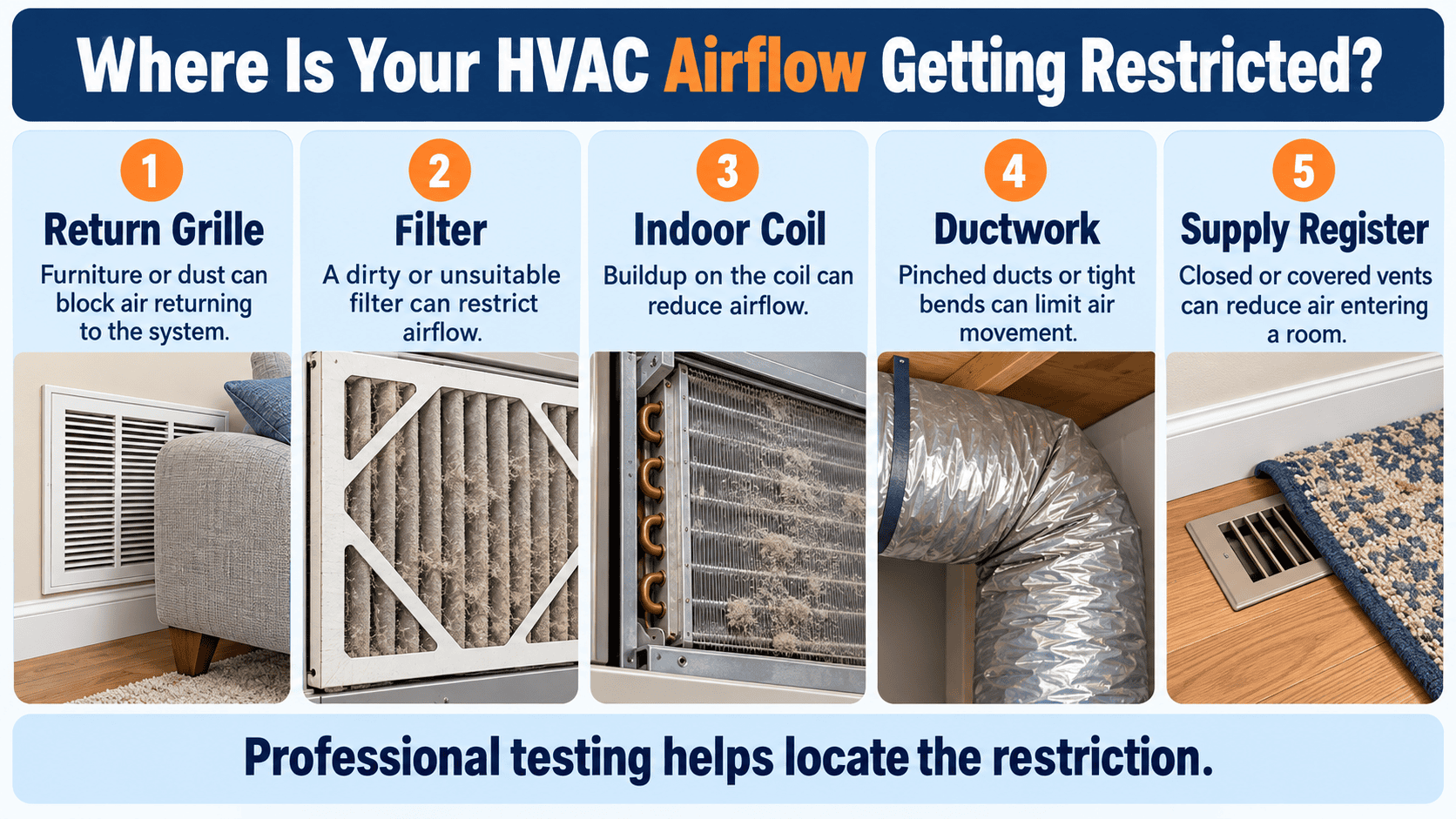
Several small restrictions can combine into a larger problem. Identifying the cause requires locating where pressure is being lost.
A Dirty Or Unsuitable Air Filter
As a filter collects debris, resistance can increase. However, choosing a replacement involves more than buying the highest filtration rating.
MERV describes particle capture performance; it does not tell you everything about a filter’s pressure drop. Filter dimensions, media design, available surface area, and operating airflow also matter.
Trane advises homeowners that higher MERV filters can restrict airflow and recommends choosing filtration that fits the system. Trane®
The goal is effective filtration with acceptable airflow. If you want better filtration, ask whether the existing filter cabinet and return system can support it.
Undersized Ducts Or Grilles
Ductwork must accommodate the airflow required by the installed equipment.
A system replacement, finished basement, or room addition may change those requirements. If the distribution system is left unchanged, the equipment and ducts may no longer work well together.
The Department of Energy emphasizes that supply and return grilles must be correctly sized, just as the ducts themselves must be. Building Science Education
Compressed Or Poorly Supported Flexible Ducts
Flexible duct can develop restrictions when it is pinched, sharply bent, or allowed to sag excessively.
These defects may be hidden in an attic or crawlspace, far from the room with weak airflow. Department of Energy guidance calls for proper support to prevent compression and avoid airflow losses. Building Science Education
A Dirty Indoor Coil
In many central systems, heating airflow travels through an indoor cooling coil even when the air conditioner is off.
Debris on that coil can therefore affect winter operation as well as summer cooling. Trane identifies dirty evaporator coils as a cause of reduced airflow and potential coil freezing. Trane®
Changing the filter does not remove contamination already attached to the coil.
Closed Registers Or Improperly Managed Dampers
Closing registers changes the air path. In a conventional system, closing multiple vents can increase resistance rather than reliably redirecting useful airflow where you want it.
Research summarized by the Department of Energy found that register closing generally did not save energy in the systems studied. rpsc.energy.gov
A professionally designed zoning system is different: its controls, dampers, and equipment must work together across operating conditions.
What Are The Signs Of An Airflow Or Static Pressure Problem?
Homeowners usually notice the effects before they hear the term “static pressure.”
Common reasons to request an airflow evaluation include:
- Weak airflow from several registers.
- Persistent temperature differences between rooms.
- Whistling at a filter opening or return grille.
- Excessive air noise.
- Comfort that worsened after an equipment or filter change.
- Recurring heating shutdowns.
- Repeated air conditioner icing.
These symptoms are clues, not proof of high static pressure. Blower faults, duct leakage, equipment sizing, insulation, controls, and other problems can produce similar complaints.
Record when the problem happens. Does it affect heating, cooling, or both? Does a bedroom become less comfortable with its door closed? Did the noise begin after installing a different filter?
That history helps guide the testing.
How Restricted Airflow Can Affect Heating And Cooling
Furnace Overheating And Interrupted Heating
A furnace needs adequate airflow to carry heat away from its heat exchanger.
When airflow is restricted, the furnace may overheat. A high-limit control can shut off the burners while the blower continues running to cool the equipment. Homeowners may experience interrupted heating or unexpectedly cool air from the registers. Carrier identifies airflow restrictions and blocked vents as possible causes of this behavior. 10 Common Causes & Fixes
Repeated shutdowns deserve diagnosis. Resetting the furnace does not correct the underlying restriction.
Air Conditioner Icing
Insufficient airflow across an evaporator coil can allow it to become cold enough for moisture to freeze.
However, refrigerant and other faults can also cause icing. A frozen coil requires diagnosis rather than an assumption that the filter alone is responsible. Trane®
Related reading: Why Does My Air Conditioner Freeze Up?
Blower Performance And Energy Use
Different blower technologies respond differently to resistance.
Some constant-airflow systems adjust operation to help maintain their target airflow as static pressure changes. That capability has limits, and it does not make restrictive ductwork acceptable. carrier.com
Research on residential furnace blowers also shows that duct-system resistance can affect the energy benefits of more efficient blower technology. rpsc.energy.gov
A modern motor is one part of a complete system.
Why Denver Homeowners Should Care
Denver’s elevation makes local equipment selection and airflow evaluation especially important.
Air at higher elevation is less dense. The volume moving through a duct and the mass of air carrying heat are therefore different considerations. Teamwork HVAC’s existing altitude guide explains how this affects airflow, capacity, and equipment selection. teamworkhvac.com
Altitude does not automatically mean your home has high static pressure. The useful question is whether the installed equipment and air distribution system meet the home’s needs under local conditions.
A Denver airflow evaluation should connect pressure measurements with equipment data, delivered airflow, temperature performance, and room comfort.
Related reading: How Does Denver’s High Altitude Affect HVAC Performance?
How A Technician Measures Static Pressure

A technician uses a pressure instrument, commonly a manometer, with appropriate probes and test locations.
The testing process should establish:
- Which equipment is installed. The model and blower configuration determine which performance data apply.
- Which operating mode is being tested. Heating, cooling, and different stages may use different airflow settings.
- Where pressure is measured. Test locations must match the equipment’s measurement convention.
- How the readings compare with manufacturer data. Pressure readings must be interpreted alongside the applicable blower information.
- Where significant restrictions occur. Additional measurements across components can help locate the cause.
Carrier’s residential airflow evaluation form specifically connects external static pressure readings with the indoor unit’s blower performance data and notes that an attached cooling coil requires appropriate treatment in the calculation. resource.carrierenterprise.com
Homeowners should not drill test holes or insert probes into equipment. Hidden wiring, refrigerant tubing, and other components can be damaged.
What Is Total External Static Pressure?
Total external static pressure, often abbreviated TESP, describes the pressure difference across the equipment’s defined external air path.
In a typical arrangement, the return-side reading is negative relative to the reference pressure and the supply-side reading is positive.
For example, hypothetical readings of:
- Return side: −0.30 inches of water column
- Supply side: +0.40 inches of water column
would produce a total difference of 0.70 inches of water column.
This illustrates the arithmetic. It does not establish an acceptable limit for your system.
The measurement boundaries, included components, blower setting, and manufacturer specifications determine how the result should be interpreted. resource.carrierenterprise.com
What Is A Good Static Pressure Reading?

There is no universal pass-or-fail number for every residential HVAC system.
A useful answer identifies the actual equipment, its approved operating limits, the test conditions, and the airflow it delivers at the measured pressure.
Ask your technician:
- What was the measured pressure?
- What specification applies to this equipment?
- Which operating mode and blower setting were tested?
- Where is the largest restriction?
- Is the required airflow being delivered?
- What measurements will confirm the repair worked?
A pressure number without that context is an incomplete explanation.
Just as importantly, an apparently acceptable total reading does not establish that every room receives the airflow it needs.
Static Pressure And Duct Leakage Are Different Problems
A restrictive duct and a leaking duct can both cause poor comfort, but they require different investigations.
Static pressure testing evaluates pressure conditions. Duct leakage testing evaluates air escaping through unintended openings.
The Department of Energy explains that ducts leaking conditioned air into unconditioned spaces can increase heating and cooling costs. Department of Energy
This distinction matters when considering repairs. Sealing a leak may reduce wasted air, while an undersized return still needs separate attention.
The goal is an air distribution system that is both sufficiently open for required airflow and sufficiently tight to deliver that air where it belongs.
What Homeowners Can Check Safely
Before arranging service, check the accessible parts of the air path.
Check The Filter
Use the specified size and type, install it in the correct direction, and replace it according to its condition and the manufacturer’s guidance.
If airflow changed after switching filters, tell the technician exactly what changed. Do not operate the system without its required filter.
Clear Supply And Return Grilles
Move furniture, rugs, curtains, and stored items away from grilles. Keep ordinary supply registers open unless a technician has established a specific balancing arrangement.
Observe Door-Related Comfort Changes
If a room becomes colder with the door closed, record that pattern. It can help identify a room return-path issue.
Record The Symptoms
Note unusual sounds, shutdowns, affected rooms, and recent changes to the house or equipment.
Leave blower adjustments, internal coil cleaning, duct modifications, and pressure testing to a qualified professional.
How Static Pressure Problems Are Corrected
The repair should follow the evidence.
| Finding | Possible Response |
|---|---|
| Excessive filter pressure drop | Review filter selection, cabinet sizing, and maintenance |
| Restricted return path | Evaluate return ducts, grilles, or room return provisions |
| Pinched flexible duct | Correct routing and support |
| Dirty indoor coil | Perform equipment-appropriate cleaning |
| Restrictive supply layout | Evaluate fittings, branch sizing, and distribution |
| Incorrect blower configuration | Set airflow according to equipment requirements |
Not every home needs extensive duct replacement. Some restrictions are localized. Other systems need more substantial changes because the original distribution system cannot support the installed equipment.
After the work, testing should confirm both acceptable equipment operation and improvement in the original comfort complaint.
Why A Bigger Furnace May Not Fix Weak Airflow
A larger furnace does not enlarge your ducts or create a missing return path.
Equipment selection should follow the home’s calculated heating load. Carrier notes that an oversized furnace can short-cycle and contribute to uneven temperatures. Carrier
Before approving replacement, ask how the proposed equipment will work with the existing distribution system.
Likewise, increasing blower speed is not a complete repair plan by itself. The final setting must meet the equipment’s airflow requirements and remain appropriate for the ducts.
Masterpiece Conclusion: Comfortable Rooms Begin With A Measurable Air Path
Weak airflow can leave homeowners caught between conflicting explanations: replace the furnace, buy a better filter, close a few vents, or install a stronger blower.
Static pressure testing provides a way to investigate those recommendations.
Its value comes from connecting measurements to the actual equipment and locating the restriction. When paired with airflow verification and room-level evaluation, it helps explain why a system runs without delivering the comfort you expect.
For Denver homeowners, that means a clearer path forward: understand what the house needs, determine what the equipment delivers, and correct the gap with evidence.
Before spending more to produce heating or cooling, make sure your home can distribute it.
Frequently Asked Questions
1. What Is Static Pressure In An HVAC System?
Static pressure is the pressure air exerts within the system. Technicians use it to evaluate the resistance the blower must overcome while circulating air.
2. What Causes High Static Pressure?
Possible causes include restrictive filters, undersized ducts or grilles, dirty coils, compressed flexible ducts, and closed registers. Testing helps identify the location and cause.
3. Is Static Pressure The Same As Airflow?
No. Static pressure measures pressure conditions; airflow measures the volume of air moving through the system. Both help evaluate performance.
4. What Static Pressure Should My Furnace Have?
The appropriate limit depends on the furnace model, blower configuration, and manufacturer’s testing instructions. A generic number should not replace equipment-specific data.
5. Can A High-MERV Filter Cause Airflow Problems?
It can if the filter’s pressure drop is unsuitable for the system. MERV measures filtration performance, so filter dimensions and design also need consideration.
6. Does Closing Vents Help Other Rooms Get More Heat?
It may increase resistance and does not reliably solve uneven heating. Persistent room comfort problems deserve airflow and return-path evaluation.
7. Can Restricted Airflow Make A Furnace Shut Off?
Yes. Restricted airflow can cause overheating and trigger a high-limit shutdown. Other faults can cause shutdowns too, so the system needs diagnosis.
8. Will A Variable-Speed Blower Fix Restrictive Ductwork?
Not necessarily. Some blowers can compensate for changing resistance within limits, but the duct system still needs to support the required airflow.
9. Can I Measure Static Pressure Myself?
Professional testing is recommended. Accurate interpretation requires appropriate instruments, safe test locations, operating conditions, and manufacturer data.
10. When Should I Request An Airflow Evaluation?
Request one for persistent weak airflow, noisy returns, uneven temperatures, recurring shutdowns, or comfort problems that continue after basic filter and grille checks.

What You Should Do Next
Check your filter, clear accessible grilles, and write down when the problem occurs.
If comfort remains uneven or the equipment repeatedly interrupts heating or cooling, arrange a diagnostic visit. Ask for the measured results, the equipment specifications used to interpret them, and the evidence behind any recommended repair.
Get Answers About Your Home’s Airflow
Weak airflow? Noisy vents? Rooms that never feel comfortable?
Request professional airflow and static pressure diagnostics from Teamworks Mechanical. Discuss the symptoms, identify the restriction, and understand your options before making equipment changes.


