


Denver’s elevation shapes nearly every aspect of local HVAC performance.
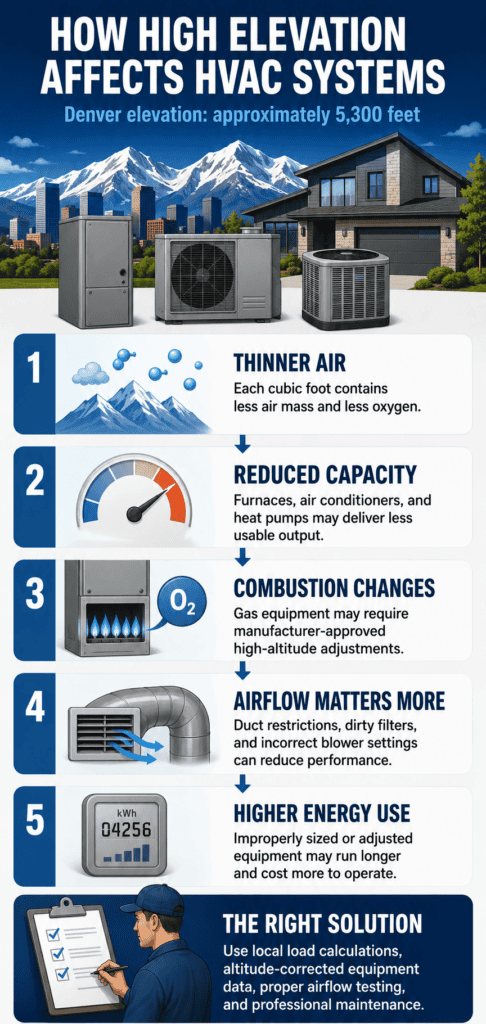
At approximately one mile above sea level, the air is thinner than it is in most American cities. Each cubic foot of air contains less mass and fewer oxygen molecules. Although homeowners cannot see this difference, furnaces, air conditioners, heat pumps, blowers, duct systems, and combustion appliances all respond to it.
An HVAC system selected only by its advertised capacity may not deliver that same capacity when installed in Denver. Equipment must be evaluated for the home, the local climate, and an elevation of approximately 5,300 feet.
The City and County of Denver specifically requires residential HVAC designs to account for altitude correction when equipment is selected. Its HVAC design guidance calls for Manual J load calculations, Manual S equipment selection, manufacturer performance data, and documented altitude corrections—not estimates based solely on square footage.
Understanding these effects helps explain why two identical HVAC systems can perform differently in Denver and at sea level.
Also Read:Colorado AC Storm Damage | How Summer Storms Affect Your Air Conditioner
The Short Answer: What Does High Altitude Do to an HVAC System?
Denver’s high altitude can affect HVAC performance in several connected ways:
- Gas furnaces and boilers may produce less usable heat unless they are configured for high-altitude operation.
- Air conditioners and heat pumps may have less effective heating or cooling capacity.
- Blowers may need to move a greater volume of air to transport the same amount of heat.
- Duct restrictions and dirty filters can have a more noticeable effect.
- Combustion equipment requires altitude-appropriate setup to burn fuel safely and efficiently.
- Denver’s dry climate can make indoor comfort and humidity control more complicated.
- Equipment sizing based only on the nameplate rating can produce disappointing results.
Altitude does not automatically make an HVAC system inefficient. It changes the conditions under which the equipment must operate. Proper selection, installation, adjustment, and maintenance allow modern systems to perform successfully in Denver.
Why Is Denver’s Air Thinner?
Atmospheric pressure decreases as elevation increases. Because Denver sits more than 5,000 feet above sea level, a given volume of outdoor air contains less mass than the same volume at a lower elevation.
This distinction matters because HVAC systems do not simply move “space.” They move air mass, and that air mass carries heat.
A blower can still move 1,000 cubic feet of air per minute in Denver, but those 1,000 cubic feet contain less air mass than they would at sea level. As a result, the same cubic-feet-per-minute measurement does not necessarily transport the same amount of heat.
This principle affects both heating and cooling:
- A furnace depends on airflow to carry heat away from its heat exchanger.
- An air conditioner depends on airflow across its evaporator coil.
- A heat pump depends on airflow during both heating and cooling.
- A duct system must distribute the required airflow without excessive resistance.
- Gas-fired equipment depends on an adequate supply of oxygen for combustion.
High-altitude HVAC design is therefore not about one isolated adjustment. It involves the interaction between equipment capacity, airflow, combustion, duct design, temperature, and the building itself.

How High Altitude Affects Gas Furnaces
A gas furnace mixes fuel with air and burns that mixture to produce heat. At Denver’s elevation, each cubic foot of combustion air contains less oxygen.
If fuel input were left unchanged while the available oxygen decreased, the air-to-fuel relationship could become incorrect. Depending on the appliance, this may contribute to incomplete combustion, soot, unreliable ignition, excessive carbon monoxide production, or damage to furnace components.
Manufacturers address this through approved high-altitude procedures. Depending on the furnace, these may involve:
- Adjusting manifold gas pressure
- Changing burner orifices
- Configuring high-altitude control settings
- Confirming gas type and supply pressure
- Measuring combustion performance
- Verifying venting and combustion-air provisions
These adjustments must follow the instructions for the exact furnace model. A universal rule or generic pressure setting should not be substituted for manufacturer data.
Does a Furnace Lose Heating Capacity at Denver’s Elevation?
In many cases, yes.
A furnace’s fuel input may need to be reduced, or derated, because of the lower oxygen density. Lower fuel input generally means lower heating output.
Denver’s residential HVAC design guidance illustrates a gas-combustion altitude factor of approximately 0.88 before accounting for furnace efficiency. That does not mean every furnace automatically loses exactly 12 percent of its listed output. The correct factor depends on the equipment and its approved manufacturer data.
It does mean that a furnace advertised at a particular sea-level capacity should not automatically be assumed to deliver that same output in Denver.
This is one reason “replacing like with like” can be unreliable. The old furnace may have been oversized, incorrectly adjusted, or never properly evaluated for the home’s actual heat loss.
Also Read How Often Should You Replace HVAC Filters? Myths vs Best Practices
How Altitude Affects Air Conditioners
An air conditioner removes heat from indoor air as the blower moves air across the evaporator coil. Because Denver’s air is less dense, airflow calculations require special attention.
The City of Denver’s HVAC design training describes two general approaches for certain cooling calculations:
- Apply an altitude-related reduction to the equipment’s capacity.
- Increase volumetric airflow to compensate for lower air density when supported by the equipment and duct design.
Denver’s example guidance uses a cooling-capacity correction of approximately 0.92 in one method. In another, airflow is adjusted using an air-density factor. These are design examples—not universal field settings—and the correct approach must be based on Manual S procedures and the equipment manufacturer’s expanded performance data.
What Can Happen If Altitude Is Ignored?
An improperly selected or configured air conditioner may:
- Run for unusually long periods
- Struggle during the hottest afternoons
- Produce weak airflow in distant rooms
- Develop excessive temperature differences between floors
- Consume more electricity than expected
- Short-cycle if it was oversized to compensate for poor performance
- Operate outside its intended airflow or static-pressure range
Longer operation is not automatically a defect. A properly sized modern air conditioner often runs for extended cycles during hot weather. The concern is whether the system maintains the indoor temperature, operates within specifications, and distributes cooling evenly.
How Denver’s Elevation Affects Heat Pumps
Heat pumps face two separate Denver challenges: high altitude and cold outdoor temperatures.
In cooling mode, a heat pump is affected by many of the same airflow and capacity considerations as a conventional air conditioner. In heating mode, its output also changes as outdoor temperatures fall.
That means a Denver heat pump should not be selected using only its nominal tonnage or its capacity at 47°F. The contractor should review manufacturer performance data at local design conditions and apply appropriate altitude corrections.
Important considerations include:
- Heating capacity at low outdoor temperatures
- Capacity after altitude correction
- The home’s calculated heating load
- The system’s thermal balance point
- Supplemental-heat requirements
- Defrost performance
- Airflow at the selected blower setting
- Whether the equipment is designed for a cold climate
Denver’s HVAC guidance specifically identifies heat-pump capacity at approximately 5°F as an important equipment-selection value. It also emphasizes manufacturer performance data rather than relying exclusively on generalized ratings.
A heat pump can work very well in Denver, but “heat pumps work in cold weather” is not a complete design strategy. The specific model must be capable of meeting the home’s needs under Denver conditions.
Also Read: 6 Warning Signs You Need to Replace Your HVAC System | Teamwork HVAC
Why Nominal Tonnage Can Be Misleading
HVAC equipment is often described using nominal capacity:
- A 60,000-Btu furnace
- A two-ton air conditioner
- A three-ton heat pump
These figures are useful equipment classifications, but they do not guarantee delivered capacity in a particular house.
Actual performance depends on factors such as:
- Elevation
- Outdoor temperature
- Indoor temperature and humidity
- Equipment combination
- Blower airflow
- Duct resistance
- Filter and coil condition
- Refrigerant charge
- Manufacturer-approved settings
A system labeled as three tons is not guaranteed to deliver precisely 36,000 Btu per hour after it is installed in a Denver home.
This distinction is one of the most commonly overlooked parts of HVAC replacement. Homeowners purchase installed performance—not just a number printed on a product label.
Also Read: Why Is My Air Conditioner Struggling to Keep Up During Colorado Heat Waves?
High Altitude Makes Airflow Design More Important
Because Denver air carries less heat per cubic foot, airflow problems can become particularly consequential.
Every component on the air side of the HVAC system creates resistance:
- Supply ducts
- Return ducts
- Elbows and transitions
- Dampers
- Registers and grilles
- Filters
- Evaporator coils
- Humidifiers
- Air cleaners
The blower must overcome this resistance while delivering the airflow required by the equipment.
Simply increasing blower speed is not always the answer. Higher airflow can increase noise and duct pressure, reduce filtration performance, or move the system outside the manufacturer’s acceptable operating range. An existing duct system may not be large enough to support the required airflow.
A proper evaluation considers:
- Total external static pressure
- Available static pressure
- Component pressure losses
- Duct dimensions
- Effective duct length
- Blower performance
- Room-by-room airflow requirements
Denver’s published HVAC design guidance emphasizes Manual D duct design and identifies airflow distribution as essential to comfort, noise control, efficiency, and equipment life.
Also Read: Why Do Denver’s HVAC Emissions Standards Matter for Air Quality and Comfort?
Denver’s Dry Climate Adds Another Layer
Altitude is only part of Denver’s HVAC environment. The region’s dry climate also influences comfort.
Dry indoor air can contribute to:
- Dry skin and irritated nasal passages
- Static electricity
- Shrinkage or movement in wood furnishings and flooring
- A home feeling cooler at the same thermostat setting
- Discomfort during the heating season
However, more humidity is not always better. Excessive indoor humidity can cause condensation on cold windows, walls, or other building surfaces. That moisture may contribute to staining, material deterioration, or microbial growth.
A humidifier should therefore be sized and controlled according to the home—not installed under the assumption that maximum output is always beneficial. Outdoor temperature, air leakage, insulation, windows, ventilation, and occupant activity all influence the safe indoor humidity range.
 Does High Altitude Increase Energy Bills?
 Does High Altitude Increase Energy Bills?
High altitude can contribute to higher operating costs when the HVAC system is not properly designed or maintained.
For example, a system may use more energy if it:
- Runs longer because its real capacity was overestimated
- Operates against restrictive ductwork
- Has an incorrect blower setting
- Short-cycles because it was oversized
- Uses excessive supplemental electric heat
- Burns fuel improperly
- Loses conditioned air through leaky ducts
- Has a dirty filter, blower wheel, or coil
Altitude itself is not an HVAC malfunction. The avoidable expense usually comes from failing to account for altitude during equipment selection, installation, or service.
Also Read: ⛈️Why Is My Air Conditioner Struggling to Keep Up During Colorado Heat Waves?
Why Oversizing Is Not the Right Solution
It may seem logical to compensate for altitude by installing larger equipment. That approach can create a different set of problems.
Oversized cooling equipment may:
- Cycle on and off too frequently
- Create larger temperature swings
- Increase noise
- Reduce efficiency
- Provide uneven comfort
- Place additional wear on electrical and mechanical components
Oversized heating equipment may produce short, intense cycles that leave some rooms too warm while others remain cold. It can also complicate airflow and temperature-rise requirements.
The correct solution is not automatic upsizing. It is calculating the building load, determining the equipment’s actual capacity under Denver conditions, and selecting a system that matches the two.
Also Read ⛈️Lower HVAC Bills With Smart Seasonal Efficiency Tips
What Is the Proper Way to Size HVAC Equipment in Denver?
A professional Denver HVAC design should bring three major calculations together.
Manual J: Determine the Home’s Heating and Cooling Loads
A Manual J calculation evaluates factors such as:
- Home size and orientation
- Insulation levels
- Window area and performance
- Air leakage
- Ventilation
- Duct location and losses
- Occupancy
- Internal heat gains
- Local outdoor design temperatures
Square footage alone is not enough.
Manual S: Select Equipment That Can Meet Those Loads
Manual S compares the calculated load with the equipment’s real performance at the applicable conditions.
In Denver, this is where altitude correction and manufacturer-expanded performance data become essential. The selection should reflect expected capacity at the local elevation, temperature, airflow, and indoor conditions.
Manual D: Design a Duct System That Can Deliver the Air
Even properly selected equipment will disappoint if the duct system cannot move and distribute the necessary air.
Manual D evaluates duct size, resistance, layout, fittings, static pressure, and required room airflow.
The sequence matters:
Calculate the load, select the equipment, and then design or verify the distribution system.
Signs Your HVAC System May Not Be Properly Adjusted for Denver
Altitude-related issues can resemble ordinary HVAC problems. Possible warning signs include:
- The system runs continuously without reaching the thermostat setting
- Heating or cooling is uneven
- Airflow is weak at multiple registers
- The furnace has ignition or flame-stability problems
- Soot or scorching appears near combustion components
- Carbon monoxide alarms activate
- Utility costs rise without a clear explanation
- The furnace repeatedly trips a high-temperature limit
- A heat pump relies heavily on auxiliary heat
- The system has been disappointing since installation
These symptoms do not prove that altitude is the cause. Dirty components, duct leakage, refrigerant problems, failing controls, poor insulation, incorrect installation, and ordinary equipment wear can produce similar symptoms.
A complete diagnostic evaluation should identify the actual cause before repairs or replacement are recommended.
Safety note: Leave the building and contact emergency services or the appropriate utility if a carbon monoxide alarm sounds or occupants experience possible carbon monoxide symptoms. Do not attempt to correct gas pressure, burner orifices, combustion settings, or venting yourself.
How to Improve HVAC Performance at High Altitude
Homeowners can help protect system performance by focusing on a few practical priorities:
Choose a Contractor Who Uses Local Design Conditions
Ask how the contractor accounts for Denver’s elevation, outdoor design temperatures, and manufacturer performance data.
Request a Load Calculation Before Replacement
A previous system’s size is not proof that it was correct. Changes to windows, insulation, air sealing, additions, or ductwork can also change the required capacity.
Have Airflow and Static Pressure Tested
Temperature readings alone do not reveal whether the blower and duct system are operating correctly.
Maintain Filters and Coils
Airflow restrictions matter in every climate, but they can be especially harmful when a system is already working with less-dense air.
Schedule Combustion Testing for Gas Equipment
A visual flame check is not a substitute for proper measurement. Gas-fired equipment should be evaluated with appropriate instruments and manufacturer procedures.
Evaluate the Whole House
Comfort problems may originate in the equipment, ductwork, insulation, air leakage, controls, or ventilation. Replacing one component without identifying the actual limitation can leave the original problem unresolved.

Common Myths About High-Altitude HVAC
Myth: Every Denver Home Needs Oversized Equipment
Oversizing is not a substitute for accurate design. Equipment should be selected according to the calculated load and its altitude-corrected performance.
Myth: High-Efficiency Equipment Automatically Solves Altitude Problems
Efficiency ratings and available capacity are related but different. High-efficiency equipment must still be properly selected, configured, and installed for local conditions.
Myth: Furnaces Automatically Adjust to Any Elevation
Some modern systems provide sophisticated controls, but manufacturer-approved high-altitude setup may still be required. Never assume the equipment is correctly configured without verifying the specifications.
Myth: More Blower Speed Always Fixes Weak Performance
Airflow must remain within the equipment’s approved range, and the duct system must be capable of carrying it. Excessive blower speed can create noise, pressure, and comfort problems.
Myth: Heat Pumps Cannot Work in Denver
Properly selected cold-climate heat pumps can operate effectively in Denver. Their low-temperature capacity, altitude correction, controls, and supplemental-heat strategy must be evaluated for the individual home.
Also Read ⛈️Ductless vs Central HVAC: Which System Fits Best?
Frequently Asked Questions
How much capacity does HVAC equipment lose in Denver?
There is no single percentage that applies to every system. Denver’s technical guidance includes example correction factors of approximately 0.88 for certain heating calculations and 0.92 for one cooling-capacity method, but the correct value depends on the equipment type, operating condition, airflow, and manufacturer data.
Does an air conditioner need special high-altitude equipment?
Not necessarily. Many conventional systems can operate successfully in Denver when they are properly selected, matched, installed, charged, and configured. The contractor must verify actual performance under local conditions.
Do Denver furnaces need high-altitude adjustments?
Many gas furnaces require altitude-specific setup or derating. The exact procedure must come from the manufacturer’s instructions for that model.
Is a bigger furnace better at high altitude?
No. An oversized furnace may short-cycle, produce uneven temperatures, increase noise, and place unnecessary stress on components. The furnace should be matched to the home’s calculated heat loss after altitude correction.
Do heat pumps work at 5,000 feet?
Yes, but their actual heating and cooling performance must be verified at Denver’s elevation and expected outdoor temperatures. Nominal tonnage alone is insufficient.
Does altitude change refrigerant pressure?
Refrigerant-system measurements must be interpreted using the manufacturer’s charging procedure and appropriate instruments. Atmospheric pressure can affect gauge-reference readings and evacuation measurements, so technicians must use altitude-aware service practices.
Can a dirty filter cause more trouble at high altitude?
Yes. A dirty or overly restrictive filter reduces airflow. Since Denver’s air is already less dense, additional airflow restriction can further reduce heat transfer and increase equipment stress.
How can I tell whether my system was sized correctly?
A contractor can review the home’s Manual J load, manufacturer performance data, altitude corrections, delivered airflow, static pressure, temperature change, and system runtime. The equipment label alone cannot confirm correct sizing.
Get HVAC Performance Designed for Denver—not Sea Level
It is frustrating to invest in heating or cooling equipment only to discover that it cannot keep rooms comfortable, runs constantly, or costs more to operate than expected. In many cases, the equipment itself is not the entire problem. The system may never have been selected, adjusted, or tested for Denver’s elevation and the home’s actual needs.
That matters because high altitude affects more than a furnace or air conditioner’s advertised output. It influences combustion, airflow, heat transfer, duct performance, heat-pump capacity, energy use, and long-term reliability. Ignoring those relationships can lead to repeated repairs or premature replacement without resolving the underlying issue.
Teamworks Mechanical evaluates the complete system—including the equipment, controls, airflow, ductwork, indoor air quality, and conditions inside the building. The goal is to replace guesswork with measurements and give homeowners clear, honest recommendations based on what the property actually needs.
You should not have to purchase unnecessary equipment or sort through conflicting explanations to make your home comfortable. Whether you are dealing with uneven temperatures, weak airflow, high utility bills, or an aging system, Teamworks Mechanical can help identify the real limitation and recommend a practical solution designed for Metro Denver.
For professional HVAC diagnostics, maintenance, repair, or system replacement, contact Teamworks Mechanical at 720-447-3157 or visit TeamworkHVAC.com.
Technical references: City and County of Denver Residential HVAC Design Training, ACCA Manual S Equipment Selection, and U.S. Department of Energy Cold-Climate Heat Pump Sizing Guidance.

What To Do Next. . .
How much capacity does HVAC equipment lose in Denver?
There is no single percentage that applies to every system. Denver’s technical guidance includes example correction factors of approximately 0.88 for certain heating calculations and 0.92 for one cooling-capacity method, but the correct value depends on the equipment type, operating condition, airflow, and manufacturer data.
Does an air conditioner need special high-altitude equipment?
Not necessarily. Many conventional systems can operate successfully in Denver when they are properly selected, matched, installed, charged, and configured. The contractor must verify actual performance under local conditions.
Do Denver furnaces need high-altitude adjustments?
Many gas furnaces require altitude-specific setup or derating. The exact procedure must come from the manufacturer’s instructions for that model.
Is a bigger furnace better at high altitude?
No. An oversized furnace may short-cycle, produce uneven temperatures, increase noise, and place unnecessary stress on components. The furnace should be matched to the home’s calculated heat loss after altitude correction.
Do heat pumps work at 5,000 feet?
Yes, but their actual heating and cooling performance must be verified at Denver’s elevation and expected outdoor temperatures. Nominal tonnage alone is insufficient.
Does altitude change refrigerant pressure?
Refrigerant-system measurements must be interpreted using the manufacturer’s charging procedure and appropriate instruments. Atmospheric pressure can affect gauge-reference readings and evacuation measurements, so technicians must use altitude-aware service practices.
Can a dirty filter cause more trouble at high altitude?
Yes. A dirty or overly restrictive filter reduces airflow. Since Denver’s air is already less dense, additional airflow restriction can further reduce heat transfer and increase equipment stress.
How can I tell whether my system was sized correctly?
A contractor can review the home’s Manual J load, manufacturer performance data, altitude corrections, delivered airflow, static pressure, temperature change, and system runtime. The equipment label alone cannot confirm correct sizing.


