



Small Device, Big Impact
It’s easy to overlook a thermostat. It sits quietly on the wall, rarely touched, doing its job… until it isn’t.
But here’s the truth—your thermostat is the command center of your entire HVAC system. And if it’s outdated, you’re likely losing money, comfort, and efficiency every single day.
Programmable and smart thermostats promise energy savings, remote control, and automation—but are they actually worth the upgrade?
Short answer: yes—if you choose the right system and install it correctly.
Long answer? Let’s break it down.
What Are Programmable & Smart Thermostats?
At a basic level, both types allow you to control when and how your HVAC system runs—but the level of intelligence varies.
Programmable Thermostats
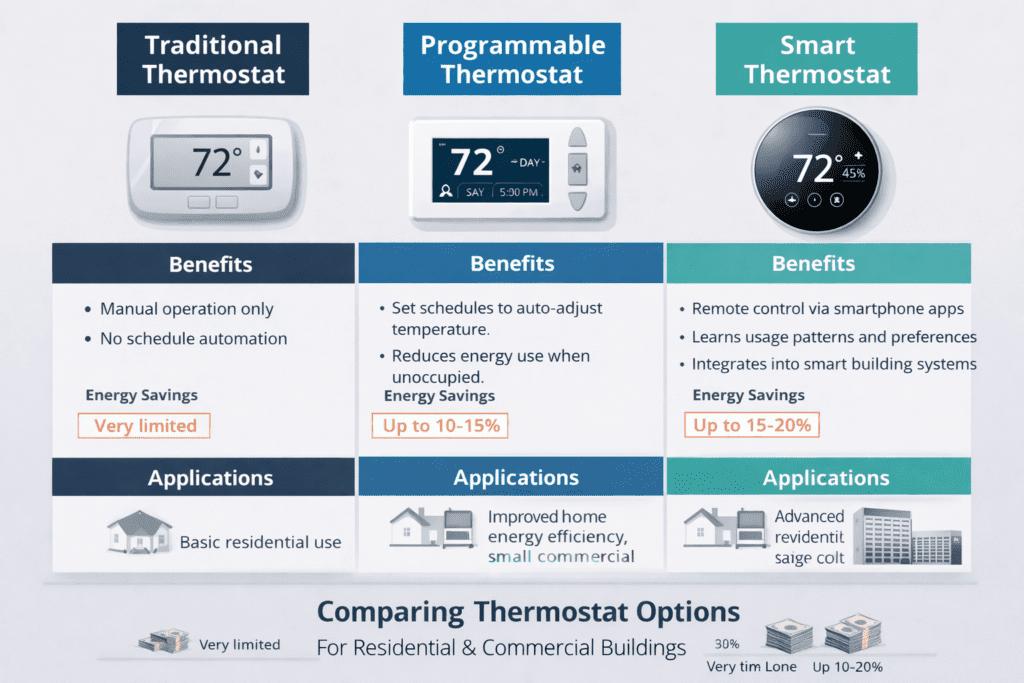
- Pre-set schedules (day/night, weekday/weekend)
- Automatically adjust temperature based on time
- Reduce energy use when spaces are unoccupied
Smart Thermostats
- Wi-Fi enabled with app-based control
- Learn usage patterns over time
- Integrate with smart home or building systems
- Provide energy reports and optimization suggestions
Think of programmable thermostats as “scheduled automation,” while smart thermostats are more like “adaptive optimization systems.”
The Real Benefits (Beyond the Marketing)
1. Energy Savings That Add Up
One of the biggest selling points—and one of the most legitimate.
- Reduce unnecessary heating/cooling during off-hours
- Optimize run cycles instead of constant operation
- Prevent overheating or overcooling
Typical impact:
-
10–20% reduction in HVAC energy use (when properly configured)
For commercial facilities or larger homes, that’s not a small number—it’s operational cost control.
2. Remote Control & Visibility
Imagine adjusting your building’s temperature from your phone… while sitting miles away.
- Change settings remotely
- Monitor system performance
- Get alerts for unusual behavior
This is especially valuable for:
- Property managers
- Business owners with multiple locations
- Seasonal or vacation properties
3. Improved Comfort (Not Just Savings)
Old thermostats operate like on/off switches. Smart systems operate like… well, systems.
- Maintain more consistent temperatures
- Reduce hot/cold swings
- Adapt to occupancy patterns
Comfort isn’t just about temperature—it’s about stability.
4. Better HVAC System Efficiency & Longevity
Here’s something most people don’t think about:
Smarter controls = less strain on your equipment.
- Fewer unnecessary cycles
- Reduced runtime extremes
- More balanced operation
That translates to:
- Less wear and tear
- Fewer breakdowns
- Longer system lifespan
Also Read 📖Thermostat Calibration For Savings
Compatibility: Where Things Get Real
Not every system plays nicely with every thermostat. This is where many DIY upgrades go sideways.
Key Compatibility Factors
- HVAC system type (forced air, heat pump, boiler, etc.)
- Wiring configuration (C-wire requirements)
- Multi-stage systems
- Zoned systems
Common Pitfalls
- Installing a smart thermostat on an incompatible system
- Missing wiring requirements
- Losing functionality (like auxiliary heat control)
Bottom line: Compatibility isn’t optional—it’s critical.
Retrofitting: Can You Upgrade an Older System?
In many cases—yes. But not always as simple as swapping devices.
When Retrofitting Makes Sense
- System is still mechanically sound
- Wiring can be adapted or upgraded
- Control system is outdated but functional
When It Gets Complicated
- Older systems with limited wiring
- Commercial systems with complex zoning
- Legacy equipment without modern control interfaces
Real-World Scenario
A small office building in a mixed-use property was running its HVAC system 24/7—simply because no one wanted to deal with the outdated controls.
After retrofitting with smart thermostats and scheduling automation:
- Energy costs dropped by ~18%
- Complaints about inconsistent temperatures disappeared
- Equipment runtime decreased significantly
No new HVAC system. Just smarter control.
Operational Impact: Why This Matters Now

Energy costs are rising. Labor is tighter. Expectations for comfort are higher.
That combination creates pressure on building systems to perform better—with less waste.
Smart controls directly address that by:
- Reducing operational inefficiency
- Supporting predictable performance
- Giving owners visibility into system behavior
This isn’t just a tech upgrade—it’s an operational strategy.
Are They Worth It? The Honest Answer
Yes—but only if:
✔ The thermostat is compatible with your system
✔ It’s properly installed and configured
✔ You actually use the features (or let it learn effectively)
No—if:
✖ It’s installed incorrectly
✖ It overrides system design limitations
✖ It’s treated like a plug-and-play gadget
The difference between “worth it” and “waste of money” is almost always installation and setup quality.
How Teamworks Mechanical Helps You Get It Right
This is where professional guidance makes a real difference.
Teamworks Mechanical focuses on:
- Evaluating system compatibility before upgrades
- Recommending the right control system (not just the newest one)
- Ensuring proper wiring, configuration, and calibration
- Integrating controls with overall HVAC performance goals
Because the goal isn’t just a smarter thermostat—it’s a smarter system.
Forward-Looking Insight: Where This Is Headed
Over the next 2–5 years, expect:
- Increased integration with building automation systems
- AI-driven predictive climate control
- Greater demand for energy transparency and reporting
- Stronger alignment with sustainability and compliance standards
Smart thermostats today are just the entry point.
Tomorrow? Fully intelligent environmental control systems.
(FAQs)
-
Do smart thermostats really save money?
Yes, when properly configured, they can reduce HVAC energy usage by 10–20%. -
Can I install a smart thermostat on any HVAC system?
No, compatibility depends on system type and wiring configuration. -
What is a C-wire and why does it matter?
A C-wire provides continuous power needed for many smart thermostats. -
Are programmable thermostats still worth it?
Yes, especially for simpler systems where smart features aren’t needed. -
Do smart thermostats work in commercial buildings?
Yes, but they must be integrated properly with larger HVAC systems. -
Can smart thermostats extend HVAC system life?
They can reduce wear by optimizing system cycles and operation. -
Is professional installation necessary?
Highly recommended to ensure compatibility and proper performance. -
What happens if a thermostat is installed incorrectly?
It can cause system inefficiency, malfunction, or even equipment damage. -
Can I control multiple locations from one app?
Yes, most smart systems allow multi-location control and monitoring. -
How long does it take to see energy savings?
Typically within the first billing cycle after proper setup and usage.
Also Read 📖What Do Colorado’s 2026 Emissions Laws Mean for Denver Homeowners?