



The Cost Problem Most People Accept (But Shouldn’t)
If your energy bills spike every summer and winter, you’re not alone—but you are leaving money on the table.
Most homeowners and facility managers assume rising HVAC costs are unavoidable. In reality, a significant portion of heating and cooling expenses comes from inefficiencies—small leaks, outdated habits, or overlooked maintenance issues that quietly drain energy (and your wallet).
The good news? You don’t need a full system replacement to see real savings. With the right adjustments, many properties can reduce HVAC energy usage by 15–30% or more.
Let’s break down exactly how to do it—season by season, system by system.
Why HVAC Efficiency Matters More Than Ever
Energy costs aren’t just fluctuating—they’re trending upward. At the same time:
- Buildings are expected to meet higher efficiency standards
- Occupants demand consistent comfort
- Equipment costs and labor shortages make inefficiency expensive
That means optimizing your current system isn’t just smart—it’s necessary for long-term cost control and operational stability.
1. Insulation: The Foundation of Energy Efficiency
If your building can’t hold temperature, your HVAC system is forced to work overtime.
Common Problem:
Poor insulation allows heat to escape in winter and enter in summer—forcing your system into constant recovery mode.
High-Impact Areas to Address:
- Attics and roof spaces
- Exterior walls
- Basements and crawl spaces
- Around ductwork
Real Impact:
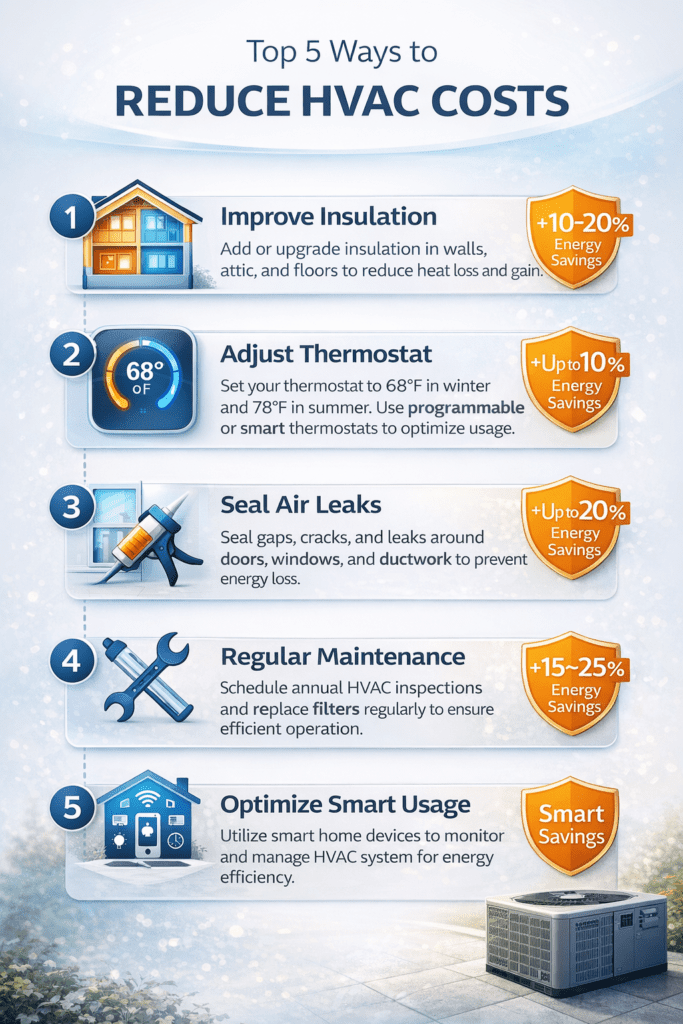
Proper insulation can reduce heating and cooling costs by 10–20% depending on the building.
👉 Think of insulation as your first line of defense—before your HVAC system even turns on.
2. Thermostat Strategy: Small Changes, Big Savings
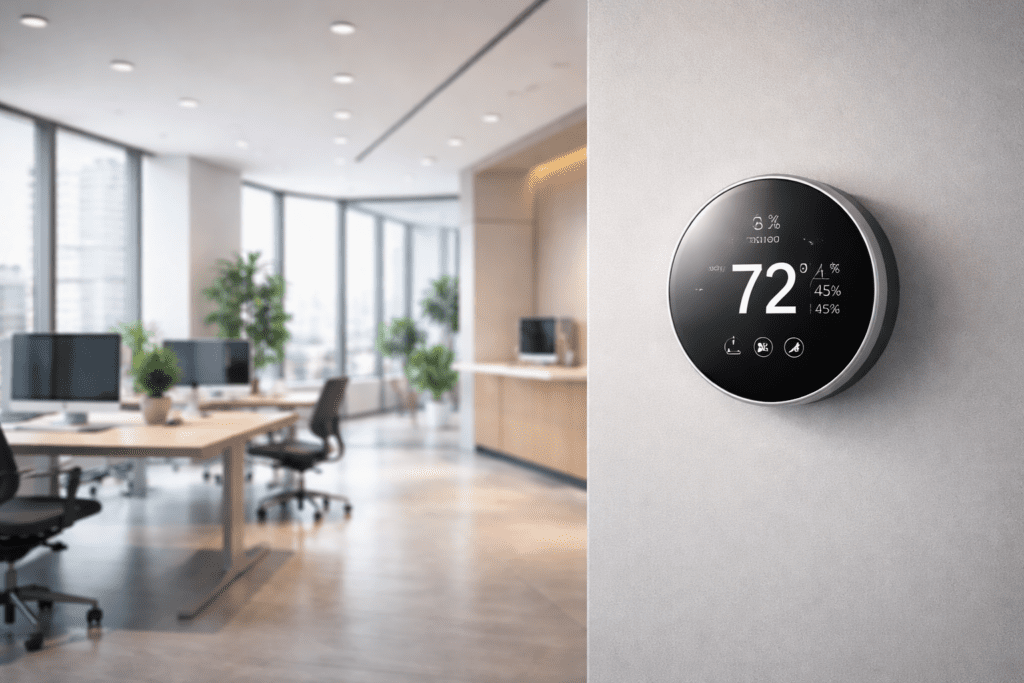
Your thermostat is one of the simplest—but most powerful—tools for energy control.
Best Practice Settings:
-
Winter: 68°F when occupied, lower when away
-
Summer: 78°F when occupied, higher when away
Smart Upgrade:
Programmable or smart thermostats can automatically adjust temperatures based on:
- Occupancy schedules
- Time of day
- Usage patterns
Savings Potential:
Up to 10% annually just by optimizing thermostat settings.
👉 If your thermostat isn’t working for you, it’s working against you.
Also Read📖Programmable Thermostats & Smart Controls: Are They Worth It?
3. Air Leaks: The Silent Energy Killer
Air leaks are one of the most overlooked—and expensive—issues in any building.
Where Leaks Happen:
- Windows and doors
- Electrical outlets
- Duct connections
- Pipe and wiring penetrations
The Problem:
Conditioned air escapes, and outside air enters—forcing your HVAC system to compensate constantly.
Solutions:
- Weatherstripping and caulking
- Sealing ductwork
- Door sweeps and window sealing
Result:
Sealing leaks can improve efficiency by up to 20% in some buildings.
👉 You wouldn’t run your AC with the windows open—leaks do the same thing invisibly.
4. HVAC Maintenance: The ROI Most People Ignore
Skipping maintenance is one of the fastest ways to increase energy costs.
What Happens Without It:
- Dirty filters restrict airflow
- Coils lose heat transfer efficiency
- Components wear out faster
- Systems run longer to achieve the same result
Essential Maintenance Tasks:
- Replace or clean filters regularly
- Inspect and clean coils
- Check refrigerant levels
- Test system performance and controls
Business Reality:
Well-maintained systems can operate 15–25% more efficiently than neglected ones.
👉 Maintenance isn’t a cost—it’s a performance multiplier.
5. Usage Habits: Everyday Behavior That Adds Up
Even the best HVAC system can’t overcome poor usage habits.
Common Energy-Wasting Habits:
- Leaving doors or windows open
- Blocking vents with furniture
- Running systems in unused areas
- Constantly adjusting thermostat settings
Better Practices:
- Use zoning where possible
- Keep vents clear and unobstructed
- Maintain consistent temperature settings
- Turn systems down/off in unoccupied spaces
👉 Efficiency isn’t just about equipment—it’s about how you use it.
6. System Optimization: When It’s Time to Go Further
Sometimes the issue isn’t just behavior—it’s system design.
Opportunities for Improvement:
- Upgrading to high-efficiency units
- Installing zoning systems
- Improving duct layout and airflow balance
- Integrating building automation systems
Teamworks Mechanical Advantage:
A properly designed and optimized HVAC system:
- Reduces energy waste at the source
- Improves comfort consistency
- Extends equipment lifespan
- Supports long-term operational savings
Real-World Scenario: From High Bills to Controlled Costs
A mid-sized commercial office was experiencing extreme seasonal spikes in energy costs.
Initial Issues:
- Poor insulation in roof space
- Significant duct leakage
- Inconsistent thermostat usage
- Lack of regular maintenance
What Changed:
- Sealed ductwork and building leaks
- Installed programmable thermostats
- Implemented scheduled maintenance
Results:
- Energy costs reduced by over 22% annually
- More consistent indoor temperatures
- Fewer system breakdowns
👉 The system didn’t need replacement—just smarter operation.
Forward-Looking Insight: The Future of HVAC Efficiency
Over the next 2–5 years, expect:
- Greater adoption of smart building controls
- Increased energy regulations and efficiency standards
- AI-driven system optimization
- Higher demand for predictive maintenance
Businesses and homeowners who adapt early will benefit from:
- Lower long-term costs
- Improved system reliability
- Stronger property value and compliance positioning
Also Read 📖What Do Colorado’s 2026 Emissions Laws Mean for Denver Homeowners?
Conclusion: Efficiency Is Built, Not Bought
Lowering your heating and cooling bills isn’t about one big change—it’s about stacking smart decisions.
When insulation, thermostat strategy, air sealing, maintenance, and usage habits all align, the result is simple:
- Lower costs
- Better comfort
- More reliable performance
- That’s where a trusted mechanical partner makes the difference—helping you move from reactive fixes to proactive efficiency.
(FAQs)
1. What is the fastest way to lower HVAC costs?
Adjusting thermostat settings and replacing dirty filters are the quickest ways to see immediate savings.
2. How much can insulation reduce energy bills?
Proper insulation can reduce heating and cooling costs by 10–20%.
3. Do smart thermostats really save money?
Yes, they can reduce energy usage by up to 10% annually through automated temperature control.
4. How often should HVAC systems be maintained?
At least twice a year—once before heating season and once before cooling season.
5. Can sealing air leaks make a big difference?
Absolutely. Air sealing can improve efficiency by up to 20% in some buildings.
6. Why does my HVAC system run constantly?
Common causes include poor insulation, air leaks, dirty filters, or incorrect thermostat settings.
7. Is it better to leave HVAC on all day?
It’s more efficient to adjust temperatures based on occupancy rather than running constantly at full demand.
8. What temperature should I set my thermostat in summer?
Around 78°F when occupied for optimal balance of comfort and efficiency.
9. When should I consider upgrading my HVAC system?
If your system is over 10–15 years old or requires frequent repairs, an upgrade may improve efficiency and reduce costs.
10. How can businesses reduce HVAC energy costs?
Through system optimization, scheduled maintenance, smart controls, and building efficiency improvements.