


When Colorado Heat Arrives, Many Homeowners Notice the Same Problem
The first major heat wave of summer often brings a flood of calls to HVAC companies across Colorado.
The story is usually similar.
The air conditioner turns on. Cool air is coming out of the vents. Nothing appears broken. Yet by late afternoon, the house simply won't cool down. The thermostat may be set to 72 degrees, but indoor temperatures creep into the upper 70s. The system seems to run constantly while comfort continues to decline.
Many homeowners immediately assume their air conditioner has failed.
Sometimes that's true.
Often, however, the situation is more complicated.
Colorado presents a unique set of environmental challenges that can push even healthy HVAC systems to their limits. Understanding why this happens can help homeowners make smarter decisions, prevent unnecessary repairs, and maintain comfort during the hottest weeks of the year.

Why Colorado Heat Waves Affect HVAC Systems Differently
Colorado isn't Florida.
It's not Texas.
And it's certainly not the Pacific Northwest.
Our climate creates conditions that many HVAC systems must work harder to overcome.
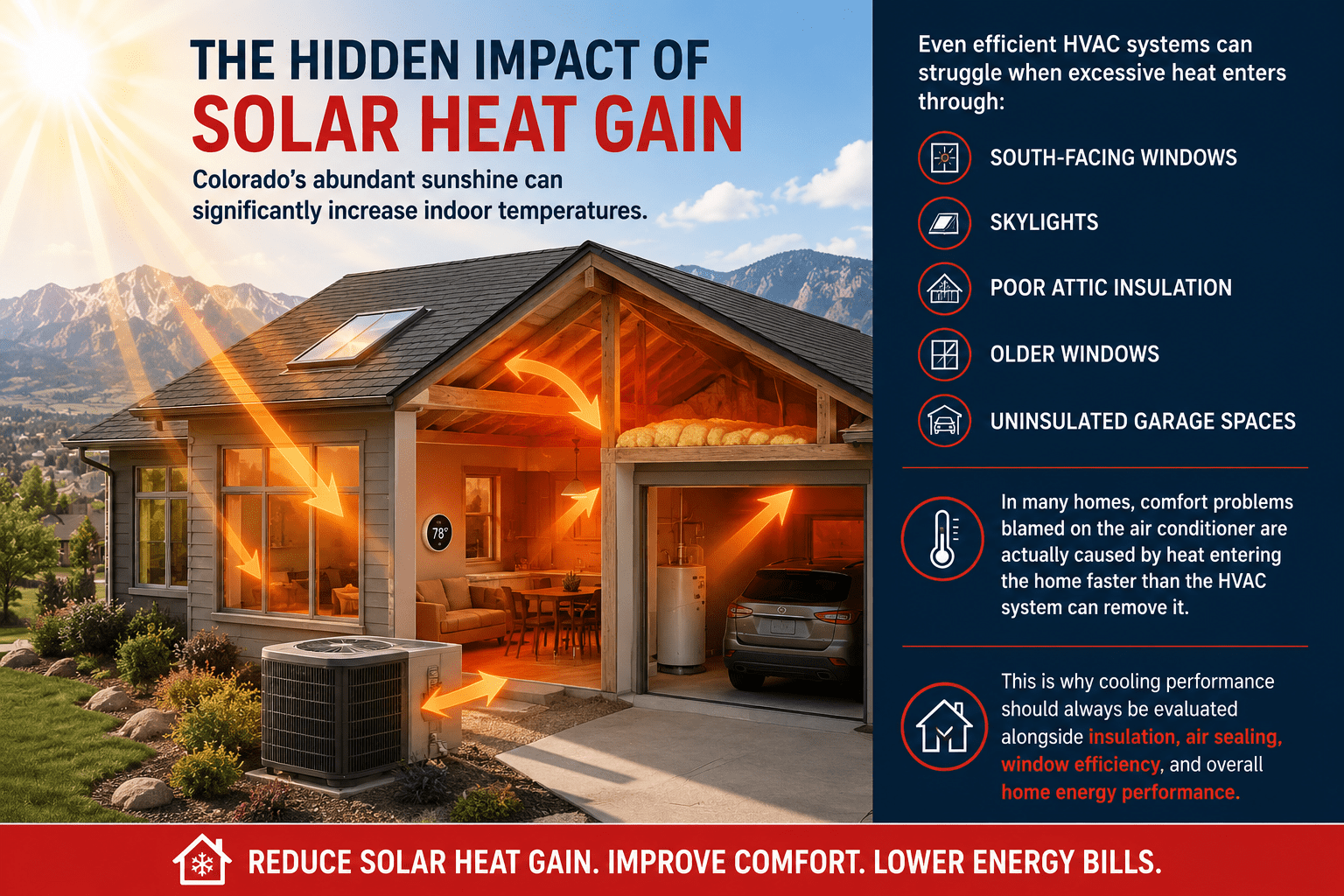
Denver averages more than 300 days of sunshine annually. While homeowners love the blue skies, that sunshine translates into tremendous solar heat gain throughout the summer.
Windows, roofs, exterior walls, and attic spaces absorb significant heat throughout the day. Even when outdoor temperatures appear manageable, sunlight can dramatically increase cooling loads inside the home.
Colorado's higher elevation also plays a role.
At higher altitudes, the air is less dense than at sea level. HVAC systems depend on airflow and heat transfer to function efficiently. Changes in air density can affect how effectively systems move heat from inside your home to the outdoors.
Add in dust, pollen, summer thunderstorms, and occasional wildfire smoke events, and it's easy to see why Colorado homeowners face cooling challenges that homeowners in many other states never encounter.
What Is Normal During a Heat Wave?
One of the biggest misconceptions homeowners have is believing their air conditioner should maintain exactly the same indoor temperature regardless of outdoor conditions.
In reality, every cooling system has limits.
Most residential air conditioning systems are designed to maintain indoor temperatures approximately 15 to 20 degrees cooler than outdoor conditions during peak demand periods.
That doesn't mean your home should become uncomfortable.
It does mean that when temperatures approach 95°F, 100°F, or higher, your air conditioner may need to run much longer than normal to maintain comfort.
Longer run times during extreme weather are expected.
The concern begins when your system cannot maintain temperature, produces uneven cooling, or causes utility bills to spike unexpectedly.
The Most Common Reason Your AC Can't Keep Up: Restricted Airflow

If there is one issue HVAC technicians encounter repeatedly throughout Colorado summers, it's restricted airflow.
Air conditioners rely on a precise volume of airflow moving across internal components. When airflow becomes restricted, cooling performance drops dramatically.
The most common culprit is a dirty air filter.
Over time, filters collect:
- Dust
- Pet hair
- Pollen
- Airborne debris
As these contaminants accumulate, airflow becomes restricted.
The system must work harder.
Energy consumption rises.
Cooling performance drops.
Indoor comfort suffers.
Fortunately, this is also one of the easiest problems to solve.
Regular filter replacement remains one of the most effective ways homeowners can improve cooling performance and protect HVAC equipment.
Colorado Dust Creates Unique Problems
Colorado homeowners are familiar with spring winds and summer dust.
What many don't realize is how much that dust affects their HVAC systems.
Outdoor condenser units are designed to release heat collected from inside the home.
When dust and debris accumulate on condenser coils, heat transfer becomes less efficient.
Imagine trying to cool yourself off while wearing a heavy winter jacket.
That's essentially what happens when condenser coils become coated with dirt.
The air conditioner continues operating, but efficiency drops significantly.
This often leads homeowners to believe their system is failing when the real issue is simply a lack of maintenance.
A Real Colorado Homeowner Scenario
Recently, a homeowner in Highlands Ranch noticed their air conditioner running nearly nonstop during a July heat wave.
The thermostat remained set at 72°F.
Despite continuous operation, indoor temperatures reached 78°F each afternoon.
The homeowner feared they needed a complete system replacement.
After inspection, technicians discovered two relatively simple issues:
A heavily clogged air filter.
And condenser coils covered with dust and cottonwood debris.
After cleaning the system and restoring proper airflow, cooling performance improved dramatically.
The homeowner avoided an unnecessary replacement and regained comfort before the next stretch of hot weather.
Stories like this occur throughout Colorado every summer.
Also Read ☀️How Often Should You Replace HVAC Filters? Myths vs Best Practices
Low Refrigerant Can Mimic Major Equipment Failure

Refrigerant plays a critical role in the cooling process.
Contrary to popular belief, refrigerant is not consumed during normal operation.
If refrigerant levels are low, a leak is typically present somewhere within the system.
Symptoms may include:
- Reduced cooling capacity
- Longer run times
- Frozen evaporator coils
- Higher utility bills
- Warm air from vents
Because refrigerant issues require specialized equipment and certification, homeowners should contact a qualified HVAC professional whenever refrigerant problems are suspected.
Also read ☀️Lower HVAC Bills With Smart Seasonal Efficiency Tips
Is Your Air Conditioner Simply Getting Old?
Like any mechanical system, air conditioners have a finite lifespan.
Most residential systems last approximately 12 to 15 years when properly maintained.
As equipment ages, efficiency naturally declines.
Components wear out.
Repairs become more frequent.
Energy costs increase.
Many homeowners continue investing in repairs long after replacement becomes the more economical solution.
A professional evaluation can help determine whether continued repairs make financial sense or whether upgrading to a modern system would provide greater long-term value.
Also Read ☀️6 Warning Signs You Need to Replace Your HVAC System | Teamwork HVAC
Repair or Replace? A Colorado Homeowner's Framework
One of the most common questions homeowners ask is whether they should repair their current system or invest in a replacement.
Generally speaking:
Repair may make sense when:
- The system is under 10 years old.
- Repairs are relatively minor.
- Energy bills remain reasonable.
- The equipment has been well maintained.
Replacement may be worth considering when:
- The system is over 15 years old.
- Major components are failing.
- Repairs are becoming frequent.
- Utility costs continue rising.
- Comfort issues persist despite repairs.
Every situation is unique, but understanding these factors helps homeowners make more informed decisions.
Also Read ☀️What Happens When Heating or A/C Systems Fail in Denver Homes?
Why Colorado Homes Require Specialized HVAC Knowledge
Not all HVAC systems operate under the same conditions.
A system installed in Denver faces challenges that are very different from one installed in Houston, Atlanta, or Seattle. Colorado's climate creates a unique combination of environmental stressors that influence system performance throughout the year.
High elevation affects air density and heat transfer. Intense UV exposure places additional stress on roofing materials, insulation systems, and building envelopes. Summer thunderstorms can create sudden humidity spikes, while dry conditions contribute to airborne dust and debris accumulation.
Many Colorado homeowners also deal with wildfire smoke events that impact indoor air quality and place additional strain on HVAC filtration systems.
This is why HVAC recommendations should never be one-size-fits-all.
An air conditioning system that performs well in another state may not be optimized for Colorado's climate.
Understanding local conditions allows homeowners to make smarter decisions about maintenance, repairs, equipment upgrades, and indoor comfort strategies.
Also Read ☀️HVAC Low NOx Commissioning Services in Colorado
Future-Proofing Your Home Against Colorado Heat Waves
Climate trends suggest that Colorado homeowners may continue experiencing hotter summers and more frequent heat events.
The good news is that HVAC technology continues to improve.
Today's systems are dramatically more efficient than those installed even 10 to 15 years ago.
Homeowners looking to future-proof their comfort should consider technologies such as:
Variable-Speed Air Conditioners
Unlike traditional single-stage systems that operate at full power or not at all, variable-speed systems continuously adjust output based on cooling demand.
Benefits include:
- More consistent temperatures
- Lower energy consumption
- Better humidity control
- Reduced wear and tear
Smart Thermostats
Modern thermostats provide homeowners with better control and energy management.
Features often include:
- Learning schedules
- Mobile app control
- Energy usage reports
- Remote temperature adjustments
Zoned HVAC Systems
Many Colorado homes have rooms that heat and cool unevenly.
Zoning systems allow different areas of the home to be conditioned independently, improving comfort and efficiency.
Improved Indoor Air Quality Solutions
Today's homeowners increasingly prioritize indoor air quality.
Whole-home filtration systems, UV air purification, and advanced filtration technologies can help reduce:
- Dust
- Allergens
- Pollen
- Airborne contaminants
while supporting HVAC performance.
Also Read ☀️Why Do Denver’s HVAC Emissions Standards Matter for Air Quality and Comfort?
How Preventative Maintenance Saves Money
Many homeowners only think about HVAC service when something breaks.
Unfortunately, by that point, repair costs are often much higher.
Preventative maintenance helps identify small issues before they become major problems.
Routine inspections can uncover:
- Dirty coils
- Refrigerant concerns
- Electrical issues
- Airflow restrictions
- Component wear
before they lead to costly breakdowns.
Preventative maintenance also helps maintain manufacturer warranties and can extend the lifespan of your HVAC equipment.
When compared to the cost of emergency repairs or premature system replacement, annual maintenance is often one of the best investments a homeowner can make.

Teamwork HVAC proudly helps homeowners throughout Colorado maintain comfortable, energy-efficient homes.
Service areas may include:
- Denver
- Aurora
- Littleton
- Centennial
- Highlands Ranch
- Parker
- Castle Rock
- Lakewood
- Englewood
- Arvada
- Wheat Ridge
- Surrounding Front Range Communities
If you're unsure whether you're within our service area, contact our team to learn more.
Conclusion
Colorado summers can be beautiful, but they can also put tremendous strain on your air conditioning system.
If your AC seems to be running constantly, struggling to maintain temperature, or causing utility bills to rise, there may be an underlying issue affecting performance.
Fortunately, many cooling problems are preventable when addressed early.
Whether the issue involves airflow restrictions, dirty equipment, refrigerant concerns, aging components, or system sizing, a professional inspection can identify the root cause and help restore comfort before the next heat wave arrives.
The key is not waiting until your system fails completely.
By taking a proactive approach, homeowners can improve efficiency, reduce repair costs, extend equipment life, and stay comfortable throughout Colorado's hottest months.

Is your air conditioner struggling to keep up with Colorado's summer heat?
Don't wait for a complete breakdown during the hottest week of the year.
Teamworks Mechanical provides professional HVAC inspections, air conditioning repairs, preventative maintenance, and system replacement services designed specifically for Colorado homes.
Contact Teamworks Mechanical today to schedule your AC evaluation and stay comfortable all summer long.
Frequently Asked Questions
Why is my AC running all day but my house is still hot?
This often indicates restricted airflow, dirty coils, low refrigerant, poor insulation, or an aging HVAC system struggling to meet cooling demand.
Is it normal for my air conditioner to run longer during a heat wave?
Yes. Longer run times are common during extreme temperatures. However, your system should still be able to maintain a comfortable indoor environment.
How often should I change my HVAC filter?
Most homeowners should replace filters every one to three months depending on pets, allergies, occupancy levels, and system usage.
Can Colorado's altitude affect air conditioning performance?
Yes. Higher elevations can impact airflow and heat transfer, making proper HVAC design and maintenance especially important.
Why are some rooms warmer than others?
Uneven temperatures are often caused by ductwork issues, poor airflow, insulation deficiencies, or solar heat gain.
What temperature should I set my thermostat during summer?
Most homeowners find comfort between 72°F and 78°F, depending on personal preference and energy efficiency goals.
How long should an air conditioning system last?
Most systems last approximately 12 to 15 years with proper maintenance.
Can dirty condenser coils affect cooling performance?
Absolutely. Dirty coils reduce heat transfer efficiency and force the system to work harder.
When should I consider replacing my air conditioner?
Replacement may be appropriate if the system is over 15 years old, requires frequent repairs, or experiences significant efficiency loss.
What is the best way to prepare for summer heat waves?
Schedule professional HVAC maintenance before peak summer temperatures arrive and replace air filters regularly.


